
[This article is from our Summer 2016 issue. To read back issues dating back to 2015, please activate your subscription]
The Reader magazine has been in existence for a very long time. When I first became editor I was handed some archival copies, one of which I have in front of me now. It is twelve issues monthly from 1932, bound together in a hard red cover and has an index for the whole year at the front. The first of them is labelled Vol XXIX, No 1, January 1932. It is therefore possible that it could have been started in 1903. The magazine has evolved, but looking at it I realise that in some senses it has changed little.
THEME
The title is snappy – The Lay Reader: a magazine for Readers and Lay Workers. The official organ of the Central Readers’ Board. The presentation by contemporary standards would be regarded as boring, although at the time it would have seemed quite fashionable! There are very few pictures, and they are only black and white.
More interesting is the content. In February, placed in a prominent position, was a note to Diocesan Secretaries imploring them to send back a completed questionnaire on Readers conducting services and another to anyone who had not yet paid their advance subscription! There is a paragraph about the forthcoming Annual Training School, the cost being £3.5s.0d, and some information about a ‘Reader (single) aged 36, ex-serviceman… requiring stipendiary post…board residence and a small allowance only required’. I am not sure the stipendiary Reader found a place as later in the year a very similar request appears.
In May we have a glimpse into preparation for Readership and we have extracts from the examination papers from the Diocese of London for 1932. These divide into three topic areas: ‘St Mark’s Gospel,’ ‘Prayer Book’ and ‘The Bible’. Each has a selection of questions of which six must be answered and those marked * are not optional. All this within an hour! You could try some of these yourself – in ten minutes how about ‘What parables are recorded by St Mark and which is peculiar to this gospel?’, or (a compulsory question) ‘How did Litanies arise and where?’ or maybe, from the final selection ‘What is the main purpose of the Bible? Illustrate your answers briefly’.
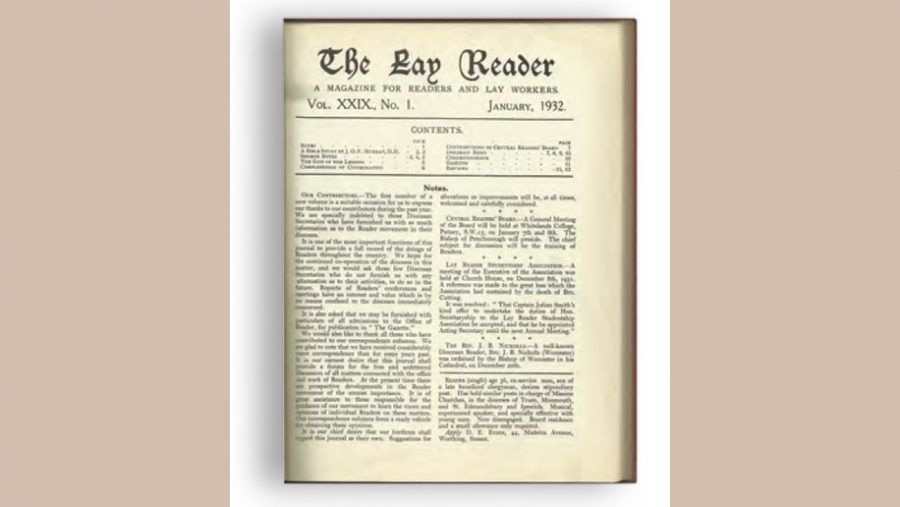
The Reader magazine for January 1932, which had no cover but was published once a month.
Correspondence pages reveal what people are concerned about and in May 1932 we discover a request for the publication of a history of the Reader movement. The writer, W.S Williams ‘Hon Sec of London R.B.’ says ‘The recent recognition of our movement by the Church Assembly marks an epoch of which it would be good to take advantage by spreading a knowledge of what the Reader office is and what Readers are doing.’ It was available at 2/- (two shillings) plus 4d for postage. At the end of his letter he helpfully adds that ‘the book contains information about respective health and unemployment insurance for Stipendiary and other paid lay-workers’. Someone who has already seen the book says he read it with ‘intense and sustained interest’ and hopes that ‘it will lead to a more willing recognition of (Readers) services’. Talking of books, later in the year we discover reference to the fact that in 1918 the Readers Board published a book ‘Teaching the Faith to Children’,price 1/6, postage 2p.
Each month has some sermon notes but again in May we see evidence of the presence of these being questioned. Frank Lipscomb from Shephall in the Diocese of St Albans writes: ‘Sir – I sincerely hope that “Sermon Notes” will be retained. I find them most helpful.’ He goes on to highlight the best one which he says is ‘a matter of the moment’, namely ‘Summer- Time Sunday’?! Some comments are less obscure: T Stevens Allen from Brighton says he ‘sincerely hopes that no change will be made in the range of matter, the arrangement of the material or in the format’. He points out that ‘The Sermon Outlines also should, I think, be retained as extremely useful to our younger brethren as well as to others. I consider the magazine, under its present editors, to be just perfect’. What more could you want as an editor? Anyway it seems that they kept ‘Sermon Notes’ as they are there at the end of the year although I am not sure what we would make of them today!
Reader ministry was not just about services as is often supposed. There are communications about ‘Visitations’, not of the archidiaconal kind but sitting and listening whilst having a cup of tea. (The Readers are of course referred to as ‘he’ as women were not admitted to Readership at the time.) J. G Harris of Oxhey observes that ‘there is no doubt that many of my Brethren would be able to deal competently and carefully.. with this work’, also suggesting that they may be more natural in the way they did it than the clergy!
Then there are those who are most close to my heart. Someone who calls himself ‘Countryman’ (pseudonyms seem to have been allowed) points out that some people do not seem to understand the problems associated with living in a rural parish. With no internet or Amazon, he complains that they find it hard to learn about modern movements ‘such as the Theology of Bart and the Oxford “Group” movement but have no means of getting proper communication’.
Finally I like the comment from the editor ‘We regret that we are obliged to holdover to the next month a number of letters’ because of the lack of space. Yes, I know all about pressure and prioritising contributions – and no internet communications will solve that one!
And then 60 years on in 1996
A couple of years ago someone gave me a small pile of The Reader magazine from the 1990s. These were A5, therefore smaller than in the 1930s, on poorer quality paper and with a floppy blue cover. Gone is the fashionable typography; the budget was obviously smaller. The editor’s wife supplied some line drawings and sometimes one of these appeared on the cover. However the contents are still very informative and again give us a picture of how Reader ministry was perceived and resourced.
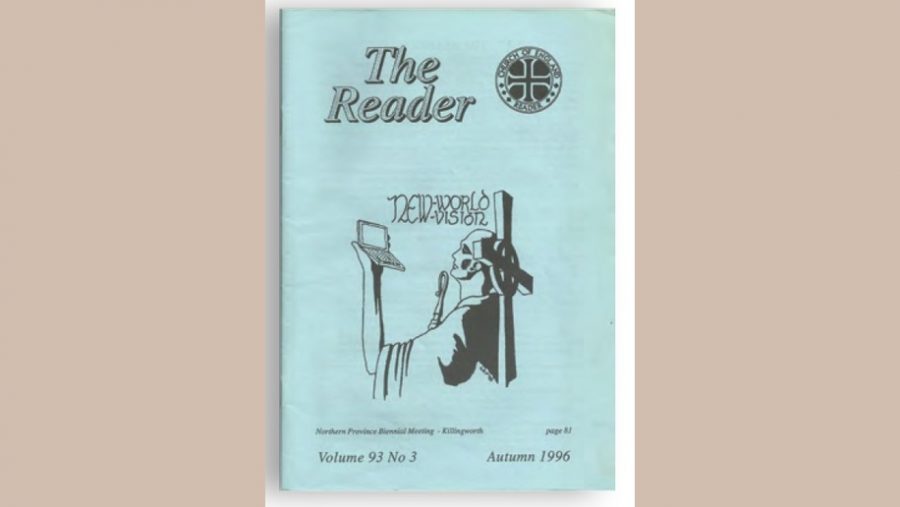
The 1996 version below, published once a quarter, is a smaller format, but does have an illustrated cover which was apparently drawn by the wife of the editor.
Looking at the content of Volume 93, no 3, I can see however a clear relationship between this and the magazine today and this issue which celebrated the 120th anniversary of the modern Reader movement. It has some of the same advertisers and feels fairly modern with someone selling sweatshirts with an embroidered Reader badge on it. (Or if you don’t fancy that, a fish or a dove motif!) There is also a Gazette and In Memoriam as well as some Book Reviews, but no Last Word.
In what I take to be the editorial, the first article entitled ‘New World- New Vision’, talks of the Northern Province Readers’ Biennial meeting at which it was said that Readers in the Victorian era were seen either as ‘of great use to the church’ or ‘were barred from preaching in consecrated buildings’. The article then goes on to warn of the danger of institutionalising the work of either lay or ordained ministries, making them too neat and organised. The picture was, it is claimed, more chaotic. Ministry ‘could not be seen as neat concentric circles but a series of encounters, not all of which were pointing to a central point’.
The next article is fascinatingly entitled ‘Reader Ministry in the 21st Century’. Most of the suggestions are fairly generalised but they all point to a broadening out of church centred ministry – taking services and preaching – to be more experimental and collaborative. There was obviously concern about what ‘post-modernism’ was and the author points out that ‘TV and film constantly blur the line between reality and fiction’. These were the days before the common use of the internet or the existence of social media, but we discover that at last The Reader was available on tape – at a cost – for anyone who was visually handicapped. Technology had begun to arrive!
A selection from the postbag shows us something of what Readers (no references to LLMs here – sorry!) were concerned about.’ ‘Is there a role for Readers in Chaplaincies?’ one asked. Another thinks that Readers are more clerical than the clerics. Most of the correspondents are men, but one women from the Diocese of Europe is disturbed by the phrase ‘Readers Rights’ asking ‘do we have any rights? Should we be demanding rights?’ She says she is after all part of the Christian church and, as a servant, she offers her service ‘where it is needed to the priest or to the laity.’ Yes, quite right; sensible woman!
Finally, and in common with the first issue of The Reader in 2016, there is an article about foot- washing (John 13:14), seeing it as the forgotten commandment. Well yes! The author goes on to say that this offered a practical way of true leadership form humility and service. Perhaps this is the message for us too…?
And into the twenty first century
With the millennium came radical changes. The size became A4, it was professionally designed and printed in four colours. The new concept was headed up by my predecessor, Clare Amos, who held the editorship from 2000 to 2007. Clare developed the magazine considerably during that time. She had a large number of contacts outside the Reader movement as she worked in the Anglican Communion office, and so there was a wider variety of contributors although not so many Readers. In 2007 Clare decided to seek fresh challenges and I took over in time to edit the last issue of 2007.
Gradually over the last nine years the magazine has evolved yet again. Our designer Kevin Wild and I were commended for making it more visually accessible, people have liked the covers (some of which are my own photographs) and many people have been very complimentary about the themes chosen and the scope of the articles generally. The number of articles actually written by Readers has increased considerably; in one recent issue we reached the maximum number of these so far, I think it was fourteen!
Finally, The Reader has a very young daughter! A Reader equivalent from South Africa saw our magazine and decided to start one for the church there. It is called The Levite, and I was privileged to contribute a short article in their first issue early this year.
Heather Fenton, Editor
[This article is from our Summer 2016 issue. To read back issues dating back to 2015, please activate your subscription]