The Oberammergau Passion Play 2022


The generally accepted story is that it all started in 1634, in a time of plague and war: the plague was the bubonic plague which spread through Germany between 1632 and 1640, and the war was the thirty years war, a long and bloody series of conflicts on the European mainland, finishing with the Treaty of Westphalia in 1648. In Oberammergau, a small village in Bavaria sheltered by mountains, at first there had been no cases of plague, as they took precautions by not allowing anyone to leave or enter their village.

This ruling was broken in September 1632 by Kaspar Schisler, who longed to be with his family and sneaked home into Oberammergau. Unfortunately, he was already infected by the plague and three days later he and his family were all dead, the village was infected and more than eighty died.

The people of Oberammergau gathered together and resolved that if God spared them further loss of life, they would every ten years put on a “Play of the Suffering Death and Resurrection of our Lord Jesus Christ.” Providentially, thereafter the town was spared further deaths and the first Passion Play was performed in 1634 in the cemetery of the village church. Here it continued till the 19 th century when it moved to the place where the passion theatre stands today.

There are strict criteria about who can take part and the play is performed only by people who live in or were born in the village. The actors do not wear wigs: everyone has to grow their hair and grow a beard if they are playing a man’s part; between performances you can see them going about their daily business in the village. From a population of 5000, about 1200 take part in the performance, of which about 100 have speaking parts.

Nowadays almost half a million people come to the passion play, from all over the world.

I first read about the Passion Play in Oberammergau when I was in my teens. I had bought a first edition of Jerome K Jerome’s “Diary of Pilgrimage” where he described the journey to Oberammergau with wit and verve, echoing his most famous work “Three Men in a Boat” but struggled with his description of the Passion Play itself. He could not think what new he could say about a play which, in 1890 when he went, had already been performed for more than 250 years. It has now been performed for nearly four hundred years, and is performed at the turn of every decade, unless there is some disruption, as there was in 2020, with the Covid pandemic. Consequently, the play was postponed to 2022, its 42 nd season.

People come from all over the world, many come in parties, but there is a well organised Passion Play Office which offers local packages, booking patrons into local hotels for one or two nights, with all necessary meals and seats to attend the performance. We chose this option. We had planned to go in 2020, and were given priority in rebooking in 2022. This meant we could stay at our first-choice hotel (incidentally run by this season’s Pontius Pilate) and had great seats, in the 5000-seater theatre.

The whole village is geared for the play, with exhibitions, talks and a concert bookending the show. The play last 6 hours, in two three-hour sessions, with a long interval where the audience retreats to one of the many restaurants in the village, or in our case to our very well organised hotel.

The play itself has three intertwined staged elements, one is the narrative play, the second is a series of Old Testament tableaux and the third a sequence of chorales. The narrative play has evolved over the years, the story of course is the same: but its interpretation varies.

What moved me in the narrative play included the crowd scenes, the tensions amongst the council and the graphic and realist representation of the scourging and the crucifixion. The stage was huge, about 50 metres across, and crowds could be crowds, hundreds were on the stage, together with donkeys, sheep, goats, horses and camels. It seemed that all human life could be accommodated, amongst the actors was one woman in her nineties and a suckling babe in arms. One benefit of a partially open stage, was that pigeons when released as Jesus cleared the temple could fly harmlessly out to freedom.

There was clearly equivocation and division amongst the common people, and the council on their view of Jesus. On the council there were great supporters throughout, notably Joseph of Arimathea and Nicodemus, as well as those hostile to Jesus. I found the scourging, the suicide of Judas and the crucifixion chilling, and almost too realistic. Though reflecting afterwards, the play as a whole filled in gaps which the gospels, as succinct accounts have to leave out.

The tableaux, provided a welcome respite from the dramatic sequence of the narrative, and linked old testament incidents and prophesy to the depiction of the passion. The chorales were beautiful and added greatly to the atmosphere and aura of the performance. Like the actors, the soloists were remarkably good, considering that they all were residents of Oberamergau.

The dialogue is, of course in German. Though learning German, we were greatly helped by the verbatim translation in to English with which we were provided. All in all, it was a delightful and enriching experience. Like Jerome K Jerome, in his account, we had made a complex journey to reach the village, train, bike and foot, we came with good friends, we were very well looked after in our hotel and we even had (resolved) uncertainty on our homeward journey! I would wholeheartedly recommend it to everyone: there are still some free places this season, otherwise you will have to wait till 2030, or if that is not possible 2034, when it will celebrate its four hundredth anniversary.

COP26 – standing up for climate justice

The conference is over and the real work is now beginning.Cathy Rhodes sent this report from Glasgow.


As soon as I heard that the United Nations Climate Change Conference was to be held in Glasgow, I knew I had to take this opportunity to be there in person: to listen, hear, march, learn and pray alongside so many other people. And, although the outcome of COP26 was disappointing to many, I am glad I made it there.

There was extensive reporting in the media before, during and after the event, with an overwhelming amount of information, jargon, facts and figures, emotion, passion and political negotiation. In all forms of the media there has been much to grasp and absorb before, during and after the conference. I hope this page will help you start to navigate the post COP26 world and discern what God is calling us to do, as Christians and church leaders, in this climate emergency on God’s created earth. Alongside reflections and images from my time at COP26, you will find information and a list of resources which I hope will be helpful.


What is COP26?

COP stands for ‘Conference of the Parties’ and the twenty-sixth of these was the one hosted by the UK in Glasgow from 1st – 14th November 2021. Many believed it was the world’s last best chance to get runaway climate change under control. At the COP21 in Paris in 2015, every country agreed to work together to limit global warming to well below 2 degrees and aim for 1.5 degrees. The ‘Paris Agreement’ means that, every five years, countries will set out plans on how much they would reduce their emissions as Nationally Determined Contributions, or ‘NDCs’.


What was achieved?

Jo Chamberlain, National Environment Officer for the Church of England, wrote a final summary, recording progress made alongside the severe disappointment and lament felt by many. Jo’s list of encouragements in the final text includes:

• Coal is mentioned for the first time in a COP agreement, and remained despite last
minute interventions to ‘phase down’ not ‘phase out’.

• There is a commitment to ending inefficient fossil fuel subsidies.

• The Santiago Network is being activated, a mechanism for funding for Loss and Damage, with a commitment made to holding a process of dialogue.

• There is an increased commitment to funding for Adaptation.

• The Paris ‘rule book’ has been agreed, meaning there is agreement about how to account for carbon emissions reductions, so that pledges can be assessed and countries held to account.

• Countries agreed to come back yearly with new pledges, rather than every five years, until pledges are enough to keep temperature rises to 1.5 degrees Celsius. But much more urgency is needed, especially progress on the following:

• The gap between change needed and agreements; the Carbon Action tracker calculates that the commitment keeps us to 2.4 degrees of global warming, a long way from the all-important 1.5 degrees.

• Keeping promises to the poorest and those least responsible for a changing climate. Terms of any new financing mechanisms for loss and damage are still being discussed, not yet agreed, and the pledge of $100bn annually for adaptation and mitigation has not yet been reached.

There has been disappointment that the COP was not as inclusive as it could have been: the voices of indigenous people and other marginalised groups were not fully heard. We cannot abandon the process, as the COP allows those most affected by climate change to directly confront the biggest emitters and speak of their experience. In the very last stages of the negotiations the whole deal was threatened by some countries pushing for weaker commitments, so others needed to compromise in order to ensure some form of agreement was reached. The Maldives issued this statement: ‘We are putting our homes on the line while other [nations] decide how quickly they want to act. The Maldives implores you to deliver the resources we need to address the crisis in small islands in time … This is a matter of survival.’


What has the Church of England said post COP26?

Graham Usher, the Church’s lead bishop for the environment, and Olivia Graham, Bishop of Reading, said: ‘At COP we called for keeping global warming to below 1.5 degrees, ending fossil fuel subsidies, and securing finance for the world's most vulnerable people who are already effected by climate breakdown … Negotiations always have some compromises and disappointments. These impact the world’s economically poorest the most…. The whole world needs to do more for climate justice. More quickly. More generously. More together. During its presidency year, the UK can be a key player. And this includes all of us within the Church of England. At Glasgow, the world glimpsed the possibility of a hopeful future. Hurting God’s creation and contributing to the suffering of God’s poorest people is not the ‘love God and your neighbour’ that Jesus commands of us. COP showed us the unity of purpose people of faith can bring. This encouragement should reignite in all of us hope for our future.’

There is more information about COP26 and the full statement at https://www.churchofengland.org


••••••••••••••••••••••••••••••••••••••••••••••••••••••••••••••••••••••••••••••••••••••••••••••
Some definitions


Adaptation: altering our behaviour, systems, ways of life, to protect our families, our economies, and the environment in which we live from the impacts of climate change. The more we reduce emissions right now, the easier it will be to adapt to the changes we can no longer avoid.

Mitigation: avoiding and reducing emissions of heat-trapping greenhouse gases into the atmosphere to prevent the planet from warming to more extreme temperatures. Affecting rising temperatures takes decades, so we must adapt now to the change already upon us which will continue to affect us in the foreseeable future. It means transitioning from powering our world with fossil fuels to using clean, renewable energy. And we need to reverse deforestation and restore our natural habitats until we reach net-zero carbon emissions.

Loss and damage: impacts of climate change such as loss of life, livelihoods, ecosystems or cultural heritage which exceed the adaptive capacity of countries, communities and ecosystems. These include severe weather events, desertification and rising sea levels. Poor and vulnerable countries who did little to cause the climate crisis are asking the rich nations responsible for the vast majority of fossil fuels for loss and damage funding.

Climate justice: the severe effects of global heating caused by industrialisation and emissions from wealthy countries are felt most by those who did least to cause them. Christians have been working alongside people of faith to speak of the need for Climate Justice, related fundamentally to Jesus’s commandment to love our neighbour. As Ruth Valerio says: our faith is rooted in the scriptures that tell us God is a God of Justice, who raises the poor from the dust and lifts the needy from the ash heap (Psalm 113). We are created in God’s image, which affirms that all people are equal. So what does it mean to be and to act in the image of God? In order to reflect God, we must demonstrate that active concern for people who are living in poverty.

••••••••••••••••••••••••••••••••••••••••••••••••••••••••••••••••••••••••••••••••••••••••••••••


What can we do?


Act justly

On Saturday 6 November, we took to the streets of Glasgow as part of the faith bloc to join the COP26 Day of Action. We collected Christian Aid placards from the Sandyford Henderson Memorial Church where we saw a large image entitled ‘Same Storm, Different Boats’ by artist Geoff Thompson.
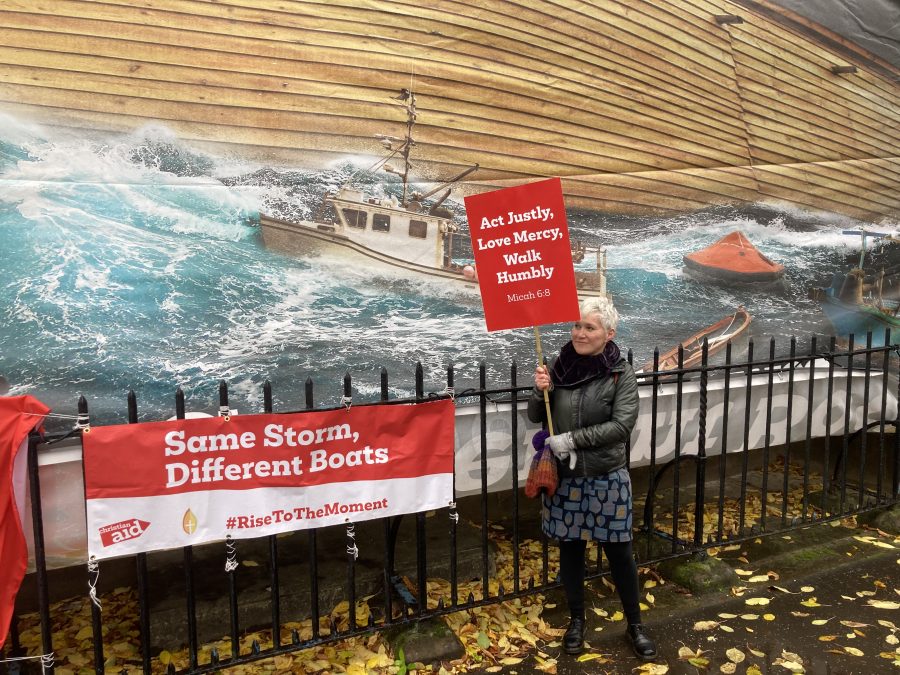
 

Cathy on the way to the March for Climate Justice.

Unlike poorer nations, larger richer nations have the resources to cope with and mitigate the effects of the climate storm. We are not all in the same boat. My placard quoted a favourite verse from Micah 6:7: ‘Act Justly, Love Mercy, Walk Humbly’. As we marched, there was a repeated call and response: ‘What do we want? Climate Justice. When do we want it? Now’. It was wet and cold that day but the energy from those present was palpable. As the images show, people from many faith communities and organisations from the Quakers to CAFOD to Christian Aid and Tearfund joined in this call alongside thousands of marchers of all ages.
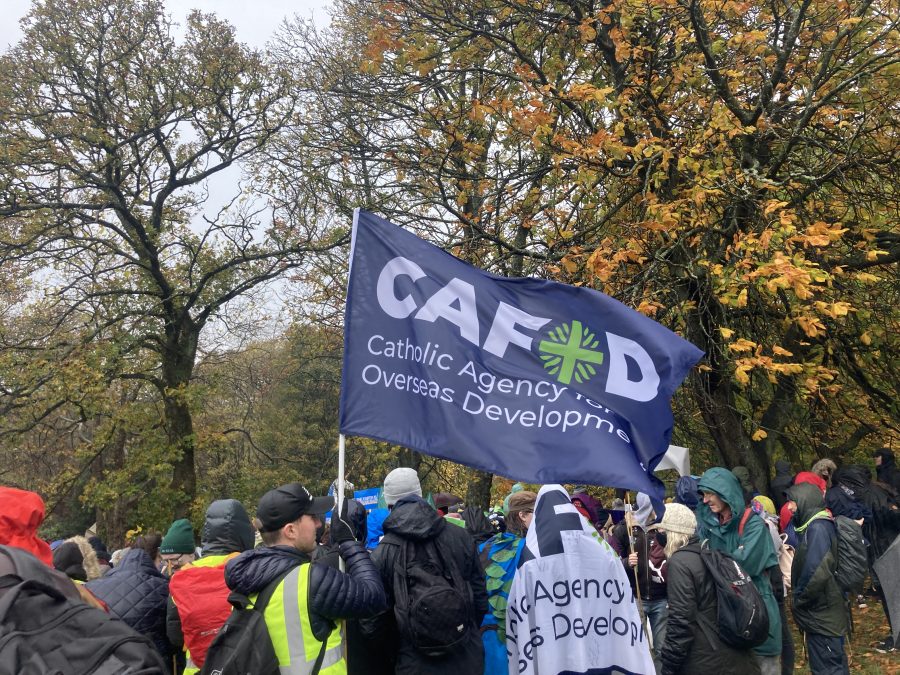
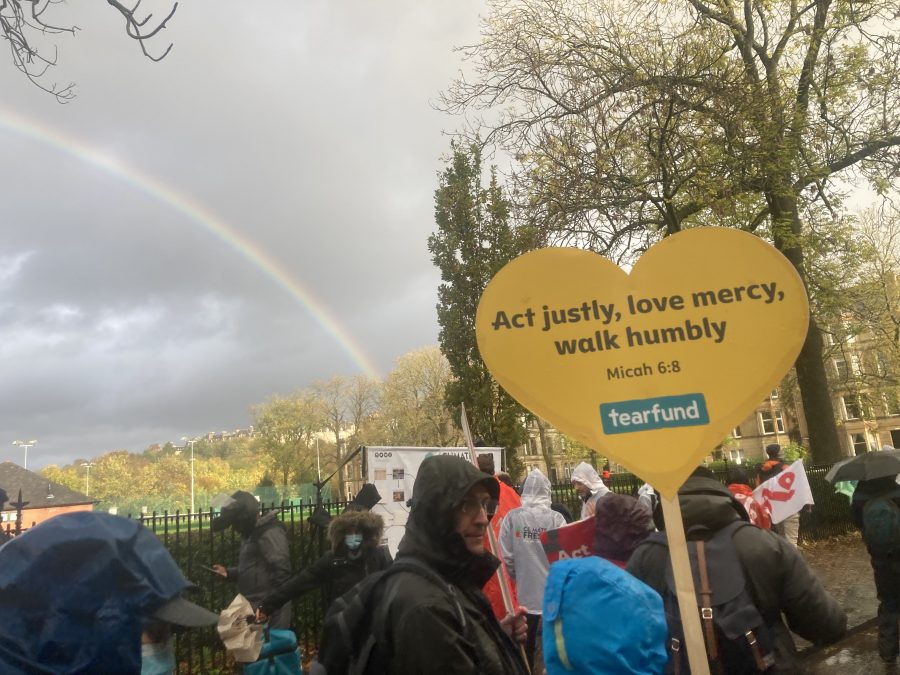
Different groups on the march

The Young Christian Climate Network (YCCN) organised a Relay from the G7 in June in Cornwall to Glasgow for COP26, and members and friends of YCCN marched with us, along with their boat, ‘The Pilgrim’. The YCCN website has helpful information especially for young people who want to get involved. Also have a look at the Tearfund/Youthscape ‘Burning down the House’ report online for sobering insight into how young Christians feel the church is not doing enough to speak up on environmental issues. The voices of the younger generations, who will survive to reap the consequences of our action and inaction, are loud and clear on this.
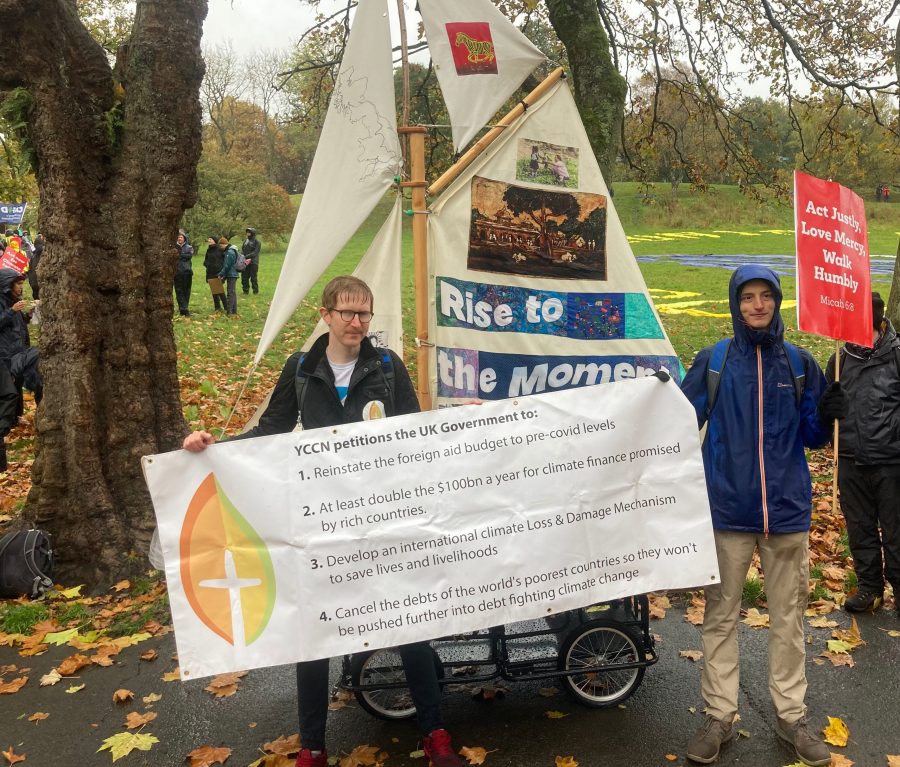
The YCCN pilgrims with their banner

We also met with people from Islamic Relief UK, who called us over to stand with them and spoke of their belief in ‘treading lightly on the earth’. One of the main signs of hope from the whole of COP26 has been the unity and solidarity shown by faith groups calling for climate justice, and how this unity has given us a stronger voice. The government’s own faith groups toolkit recognises that ‘Representing over 80 per cent of the world’s population, faith, religion and belief groups have a unique perspective on climate change – in protecting the planet and supporting those on the front line of climate change – and a reach into communities around the world.’
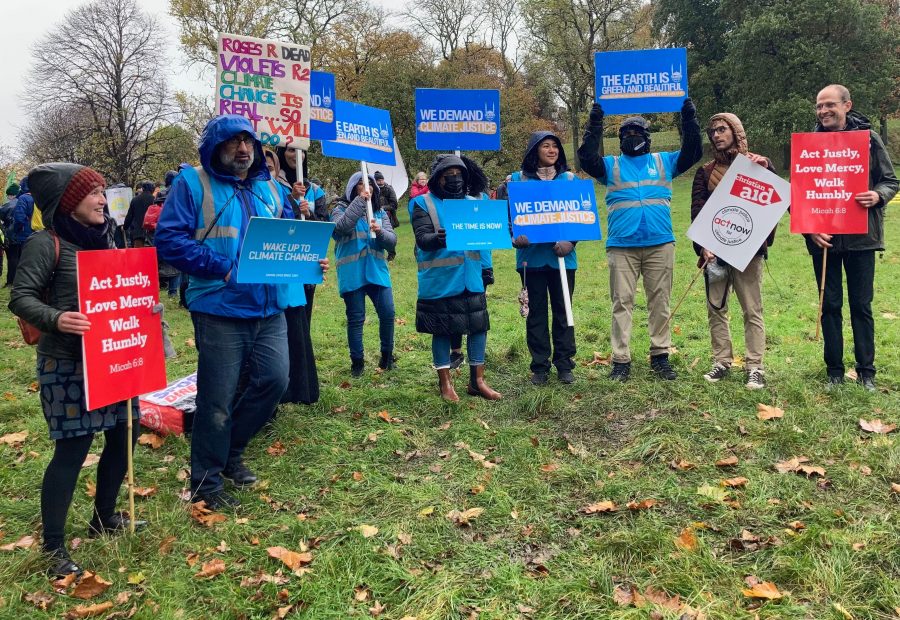
With marchers from Islamic Relief

Rob Hopkins, founder of the Transition Movement, has helpful encouragement for us: ‘If we wait for governments to do it, it’ll be too late, and if we just act as individuals, it’ll be too little, but if we act as communities, it might just be enough.’


Eco Church

Becoming an Eco Church with A Rocha gives you a structure to work to in Worship and Teaching, Lifestyle, Land, Buildings and Community and Global Engagement. The last section encourages partnership working and lobbying our local politicians for change. It is really helpful to join this scheme for ideas small and large that churches and their congregations can take up. There are now 4000 Eco Churches in England and Wales! Search online for A Rocha Eco Church for information and resources, and to sign up to helpful mailings.


Learn

There are a number of resources and workshops around to help us as Christians understand the theology and thinking behind caring for God’s creation. Look at the websites below and seek out local and national courses too.


Pray

Christian Aid encouraged people to make prayer boats, some of which were sent to COP 26. I made a boat with the suggested prayer: ‘We pray for world leaders at COP26. Bless them with wisdom and a vision of hope. Give them determination to take strong action. Amen.’ If you have sharp eyes you can spot my little blue boat in the welcome sign at the top of this article, and in some of the other photos. It went everywhere with me when I was at COP26, including in my pocket on the march, and got rather soggy! But I have it now by my desk as a reminder of the prayers which rose up around the conference and the need to continue this. For Eco Church, praying for the environment and including it in worship is a vital part of the survey and there are many resources in the links below.
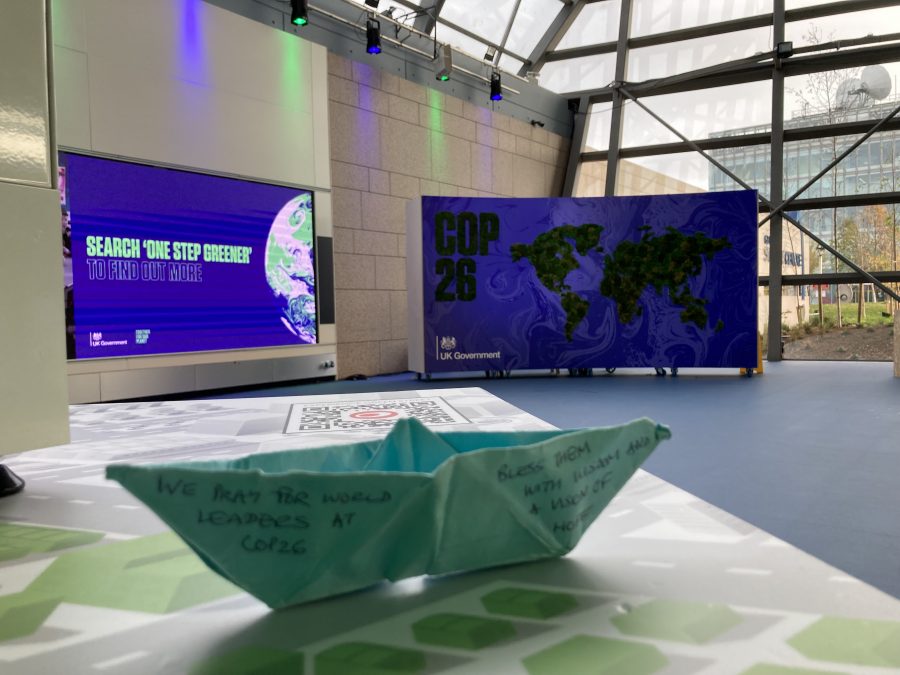
Cathy’s prayer boat has a rest


The future?

Jo’s final message gave me hope: ‘We can build on the legacy of COP, which has increased concern about climate justice in our churches and communities. We can continue to speak out and hold our leaders to account. And be encouraged in our own efforts to cut our carbon emissions, and look after creation, that these actions are all part of wider movement for change.’ During the march in Glasgow, a rainbow suddenly appeared in the sky. We all cheered as we witnessed this sign of the hope we hold in God, our creator.


••••••••••••••••••••••••••••••••••••••••••••••••••••••••••••••••••••••••••••••••••••••••••••••

To find out more

Go to greenchristian.co.uk and click on COP26 for theological reflections and a downloadable slide show on ‘Why faith matters at COP26’.

At seasonofcreation.org click on full guide for ‘A celebration guide’ with ecumenical worship and prayer resources which are helpful at Creationtide and beyond, including as part of your Eco Church ‘Worship and Teaching’ survey.

USPG produces annual five-week Bible study courses; For Such a Time focuses on ideas of ecological justice through reflections from across the Anglican Communion https://www.uspg.org.uk/engage/support5/forsuchatime/lent-course-2021/

Previous courses include ‘All Things Are Possible’ looking at the Sustainable Development Goals https://issuu.com/uspg/docs/_issuu__all_things_are_possible/2 and ‘A Heart for Mission’ about the Anglican Five Marks of Mission
https://issuu.com/uspg/docs/_issuu__a_heart_for_mission_1_

See also the reflection and advocacy guide Faith in a Changing Climate, offering stories for reflection and of action:
https://www.uspg.org.uk/engage/resources/faith-in-a- changing-climate/

Other useful sites are the Oxford Diocese Eco Hub, Church of England guidance and webinars and Green Anglicans. Search for Faith for the Climate to work together with other faith groups. Christian Aid and Tearfund have many resources on their websites. And WWF have an easy-to-use footprint tool.

••••••••••••••••••••••••••••••••••••••••••••••••••••••••••••••••••••••••••••••••••••••••••••••
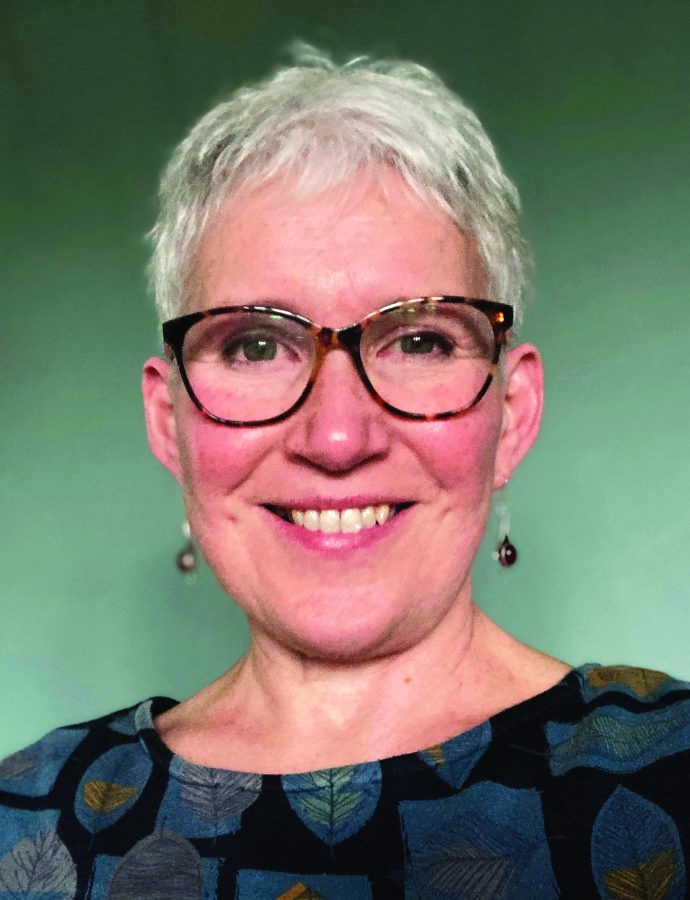


Dr Cathy Rhodes is Diocesan Environment Officer (DEO) for Sheffield Diocese. She would like to thank Jo Chamberlain, National Environment Officer for the Church of England, for her considerable input into this article.

A slightly shorter version of this article is published in the Spring 2022 issue of Transforming Ministry magazine.

Healing a grieving nation

This article from Loss & HOPE gives some helpful advice for lay ministers seeking to bring light and hope to the bereaved.

In July 2020, Coop Funeralcare released a media report entitled ‘A Nation in Mourning’, reflecting on the devastation of the Covid-19 pandemic following the first wave of infection.

It highlighted the shocking death toll, the personal tragedies of all those loved and lost, and the response of funeral industry professionals whose roles were radically changed almost overnight as restrictions on funerals came into force.

Along with all of that came the distressing forecast that the fall-out of the additional deaths in 2020 would result in a ‘grief pandemic’ to sweep the nation in the following months.

But of course, sadly, we now know that was to be only the beginning. As 2021 had barely begun, UK coronavirus-related deaths surpassed 100,000, a heartbreakingly high number of additional deaths to the usual 600,000 per annum.

Those of us engaged in funerals ministry will know how hard it has been supporting families while also having to restrict the number of mourners at funerals, knowing that those who were unable to attend were denied the opportunity to say a formal final goodbye to the person they loved.

An alarming number were unable to see or speak to them before they died. Many more were unable to share face-to-face chats and hugs at a wake, or visit and hug family and friends for the weeks and months afterwards. And receiving a pastoral visit from someone at the local church hasn’t been possible for large chunks of time.

The Revd Canon Yvonne Richmond Tulloch is the founder of AtaLoss.org, a charity which runs the UK’s bereavement signposting website. She says the pandemic restrictions have denied bereaved people the things that normally enable them to process their loss.

“Over the past 18 months many people will have put their grief on hold and for others the constant reminder of death will have opened up wounds of unprocessed grief from before. We’re now facing a ‘tsunami’ of grief,” explained Yvonne, adding that even before the pandemic, charities such as Cruse Bereavement Care had long waiting lists.

She continued: “With timely information and understanding support, most bereaved people can work through a journey that eventually brings them to a place of acceptance and peace. The AtaLoss.org website fulfils a vital, initial role in helping bereaved people to immediately find information and national services that are right for their needs.

“After that, they need to find lots of local, understanding care. That way, the more complex needs can be reserved for the specialists. In my experience, bereaved people welcome anyone who reaches out to help, even in the simplest of ways.”

Yvonne and senior colleagues working in funerals ministry in the Church of England say that churches are ideally placed to offer bereavement support because they’re located in every community and because we’re called, as Christians, to reach out to the hurting and needy. Funerals are also a part of most churches’ core ministry, so collectively, churches across the UK are coming into constant contact with many thousands of grieving families every week.

The Revd Canon Sandra Millar, the national Church of England’s Head of Welcome & Life Events, says that for many church leaders and those who are active in their church, reaching out with care to those who are grieving can be one of the most important expressions of their faith.

She said: “It might be as simple as sending a message, offering practical help, or taking time to listen. But often, we rely on the fact that those who want some support will actually ask for it, whereas now might be the moment when we need to be more proactive – for example by putting up a poster reminding the whole community that this is what we do. That’s why we’ve made posters available to churches to put up which invite people to ‘Just Ask’.*

Recent research for the Church of England showed that fewer than half the population realise that they can access a church for funerals and bereavement support, yet nearly two thirds of them think that a church should and could be a place where they find help.

This might be through special services in times of remembering, but Sandra advises that personal contacts and relationships with people from within the church, along with appropriate spaces for expressing grief, (which might be indoor, outdoor, or online), matter just as much.

Reader Kate Bradshaw has also found a sad lack of knowledge about what the church can offer, and she believes part of the answer is building a good working relationship with local funeral directors.

She explained: “Funeral directors may not always recognise when a family would benefit from a faith-based funeral, and they also want celebrants who are available to them at short notice. Raising our profile with local funeral directors as professional, capable, caring and available funeral celebrants has never been so important.”

She believes churches will need to find ways to help people feel that the person who died has been properly acknowledged and taken into God’s care, even if they aren’t regular churchgoers. Following up with people after a funeral, regardless of where it took place, and checking in with a friendly ‘how are you’ phone call, is a simple way for those deeper conversations to start.

Yvonne agrees. She passionately believes bereavement care is important to implement as part of all that a church can offer. Yvonne’s faith in this led to the creation of a coalition of Christian organisations called Loss & HOPE (www.lossandhope.org), launched in 2020 specifically to equip churches with information, advice and training to support those who are bereaved and to share ideas.

Yvonne points out that churches can adapt the level of support they offer according to their resources and time. Sharing the AtaLoss.org website at funerals, on parish websites and other communications is a basic way of supporting bereaved families and takes little time and effort.

For ministers wanting to offer longer term support and to help them build lasting relationships with people in their parish, the Loss & HOPE team are encouraging churches to run The Bereavement Journey, a self-help series of films and discussion groups for anyone bereaved with all the resources and training needed to make it easy to run online or in person. This is encouraged to provide a UK wide church response to the pandemic and includes an optional session on faith which, along with wider church support, can open the door to continued engagement with church.

For anyone wanting more information, advice or training in offering bereavement support, the following websites will help.

www.lossandhope.org – to help equip church ministers with bereavement support ideas and skills.
Email: admin@lossandhope.org.

www.ataloss.org – the UK’s central hub of services and information offering immediate help to the bereaved and directing to appropriate national and local support. Posters and contact cards can be ordered, as well as journals for supporting young people through loss and ‘Remembering Someone’ grieving badges as gifts.

www.thebereavementjourney.org – a 6 session self-help series of films and discussion for people bereaved in any circumstance, available to be run face-to-face or online.

www.churchsupporthub.org/funerals – to help churches with all aspects of funerals ministry. Several free downloads are available to help people who are unable to attend a funeral.

www.churchprinthub.org/funerals – free and paid-for resources to help churches support bereaved families on the day of the funeral and long afterwards. * The ‘Just Ask’ posters mentioned above can be found on this site.

www.churchofengland.org/funerals – refer families and funeral directors to these pages to help them understand what churches offer around the time of a funeral and beyond.

A longer version of this article can be found in the Summer 2021 issue of Transforming Ministry magazine. Subscribers can access back issues of all magazines published since the beginning of 2016.

Renewing the vision: Challenges and opportunities from Resourcing Sunday to Saturday Faith


Rosemary Walters suggests some practical ways of responding to Bishop Martyn’s vision for the future of lay ministry. ‘What next for Lay Ministry?’ – Transforming Ministry Magazine

[This article is from our Winter 2019 back issue. To read back issues dating back to 2015, please activate your subscription]

The recent booklet from CRC, Resourcing Sunday to Saturday Faith contains a wealth of exciting and practical ideas for living out our vocation as lay ministers, encouraging our congregations in their weekday witness and living out that witness ourselves. Rosemary Walters looks at how we might make best use of these suggestions in our own lives.

Here are some thoughts from the Introduction to Theme 2: Teaching the Faith

Opportunities (p. 14):

The Christian teacher

  • asks questions which provoke a new way of seeing.

Challenges:

  • Do we think that ‘asking questions which provoke a new way of seeing’ is most easily done in our preaching? How can we transfer this to non-liturgical situations? Are we prepared to go from delivering information to a mindset where we ourselves approach faith primarily with questions so that we can understand the approach of those who may be enquiring or sceptical?

Try this:

Look at an article in a local or national newspaper which you feel is of concern generally or to your community. What questions would you share about it if you were having a conversation with a friend, neighbour, work colleague which would bring a Christian perspective into the situation?

Opportunities:

The Christian teacher

  • tells stories which invite a comparison.

Challenges:

  • In our approach to Biblical narratives do we give the impression that we are insisting on historical verification at the expense of the interpretation of the story? Can we see and help others to discern the equivalents in our culture to the issues raised in the story for those who were the earliest recipients of the narrative, whether orally or in written form? Do we have a lurking suspicion that deliberately making comparisons between the story and our contemporary lives is somehow disrespectful to or trivialising the text? Are there some stories which speak so clearly across time and culture that their application to today will be obvious without further comment?

Try this:

Choose one Old Testament story, and one New Testament story about Jesus or told by Jesus. Can you think of a weekday situation where these stories have been/could be introduced naturally into discussion/conversation to provide convincing and practical comparisons to move a situation forward? What is it about these choices that makes them especially difficult or especially successful?

Opportunities:

The Christian teacher• responds to questions, shining a light to help others find their way.

Challenges:

  • When was the last time any of us were actually challenged by questions about faith from inside or outside our congregations? Do we respond defensively or answer a question with a question which shows that we are enquirers as well and are genuinely interested in looking at a variety of perspectives? How do we ensure that we aren’t just interested in promoting our own answers when questions arise?

Try this:

Ask someone outside your Christian community what is the biggest question for them about meaning and purpose in life? Then only respond by asking them questions. You can answer any questions they put to you but not give your opinions unless asked. Does this seem a constructive way forward in sharing faith?

Helpful resources:

  • Grove Booklets (see www.grovebooks.co.uk/evangelism)
  • Ev 93: The 360 Gospel of Jesus: Every Angle for Every Person
  • Ev 97: Six Big Questions: Wrestling with Objections to the Christian Faith
  • Ev 100: The Gospel Message Today: Language that Connects in Communicating the Gospel
  • Stroup, George W. (1981) The Promise of Narrative Theology: Recovering the Gospel in the Church. SCM.
  • Cupitt, Don (1991) What is a Story? SCM.


Rosemary Walters is a Reader in the parish of St Martin and St Paul, Canterbury and a member of General Synod.

[This article is from our Winter 2019 back issue. To read back issues dating back to 2015, please activate your subscription]

How LLMs can teach the faith, enable mission in the everyday and lead in Church and society

Ruth Haldane provides some answers

[This article is from our Winter 2019 back issue. To read back issues dating back to 2015, please activate your subscription]

As I travel around the country I find that LLMs are asking similar questions: How do I communicate with millennials and younger generations? How do I tell my faith story in the twenty-first century? How do I help Christians to stand up for their faith in the workplace? What about the difficult apologetics questions arising in Sunday to Saturday faith? How can my church reach out to my community? What about focal ministers, and leading in a vacancy?

Teaching the faith

The first area we have identified is the need to teach the faith to our congregations and missional communities, particularly those new to faith. We can no longer expect adults to have had a familiarity with the basics of Christianity and the Bible through school or contact with churches during their youth. Teaching the faith involves learning to tell our faith story using words and actions. We need to break out of the box, do more than preach better sermons, write better courses and model whole life discipleship, although all of these are important. Faith, prayer and witness in everyday contexts are what underpin and shape Christian lives. Teaching the faith involves enabling others to deepen their own faith so they can live the story in the workplace, on social networks and through everyday conversations, where they can tell stories of what God is doing. This may involve leading Alpha, Christianity Explored or Pilgrim Courses, but LLMs also need to operate at a different level, for example training others to lead these courses. This is the principle of replication or multiplication – growing a network of transformational lay ministers, and of others willing and equipped to lead in different ways within our church communities. As formally trained lay theologians, LLMs are ideally placed to enable new Christians to be incorporated into the body of Christ, and to do so in a way that helps them live out their faith in everyday life.

Enabling mission in the everyday

Our second response is to the changes taking place in our society, which means we are now in a new kind of missional context. The UK is sometimes described as a ‘post-Christian’ society. What implication does that have for the Church? What implication does it have for the way we communicate with those currently disconnected from Church and faith? How can we harness a generic interest in ‘spirituality’ by signposting people to Jesus, the Way, the Truth and the Life? There is a need to actively re-imagine the Church’s engagement with wider society, whether it be in rural, township or urban situations. For example, many of our parishes are experiencing housing growth through new-build estates. Do LLMs have a role here in beginning to model and birth new Christian communities on new developments? What would training for this look like?

There has already been creative re-imagining of licensed lay ministry in many parts of the country. Readers on the frontline of work and society have a great opportunity to encourage and enable Christians to live out their faith in their workplace, their social networks and their communities. Their liturgical and teaching ministry means they can grasp many creative opportunities to enable others in mission, perhaps through mentoring or coaching Christians in the workplace. I am aware of ‘soul trader’ lunchtime meetings for self-employed people, of café gatherings for isolated people, of parenting courses run in the workplace, to name just a few initiatives.

Leading in Church and society

The third response is to see LLMs as leading the way, living authentically, mentoring, motivating others in their roles/vocations, perhaps getting involved in fledgling fresh expressions of Church. And doing this always with an eye to training up leaders to take over. Roy T. Bennett says ‘Great leaders create more leaders, not followers’.1 What are we creating? Who are we leading?

Refreshed vision and values

In discussing the future focus of the CRC, we agreed on the importance of resourcing LLMs/Readers for their everyday, Sunday to Saturday ministry. Our vision was established:

To resource Licensed Lay Ministers/ Readers to enable everyday mission, teach the faith and contribute to leading in contemporary church and society.

This vision is supported by our core values:

  • Informing – providing examples of good practice and new models of teaching, mission and leadership
  • Teaching – through learning modules, publications, online learning, online books
  • Motivating – to new ways of doing things.

Responding to the need

The CRC considered how best to enable and support LLMs to play a key part in transformation of our local church communities. A questionnaire was sent out to every diocese, and it soon became clear that there is evidence of good practice throughout the country in continuing ministerial development for LLMs. There are also dioceses that are very constrained by budgets in what they can achieve in offering CMD for LLMs. The CRC is changing its focus to support all LLMs in lifelong training, as well as encouraging potential LLMs in their calling and vocation. It was therefore decided to introduce online/blended learning modules which will be accessible to all LLMs throughout England and Wales. We will also showcase good practice nationwide, to inspire and challenge others.

New identity, new resources

As part of this strategy, we are establishing a new website, introducing social media and launching a Moodle platform for blended learning modules.

The Reader is the national key publication for all LLMs/Readers in England and Wales, and its purpose is to inform, teach, inspire, build faith, share experience and give a picture of local and national developments. There are many excellent articles and resources in each edition. However, around 30 per cent of dioceses in England use the term LLM rather than Reader, and some dioceses are considering adopting other titles. In order to reflect this, from the beginning of 2020 the title of The Reader will be Transforming Ministry, with an explanatory subtitle: The magazine of the Central Readers Council. The purpose of the magazine remains the same, to support Reader/LLM ministry, and it will continue to emphasise our new direction and priorities. We are delighted that so many LLMs now contribute to the magazine, and we hope that this will continue and increase as we share with each our

initiatives and transformative ministry in our communities. We believe this is a very positive step towards the renewal of LLM ministry in England and Wales – not forgetting what has gone before, but pressing on towards our goals for the future.

Why Transforming Ministry?

Our new title refers to transforming ourselves, through our Christian journey, lifelong learning, and being equipped for ministry. It also refers to helping/enabling others to be transformed: to come to faith, to grow in faith, and to learn what it means to be disciples of Jesus Christ. And it refers to transforming our communities, wherever we lead in our church and society.

Transforming Ministry therefore encompasses our three identified pressing strands of ministry: teaching the faith, enabling mission, and leading in Church and society. Lifelong ministry and learning are at its core.

You will notice a new logo appearing in 2020, featuring the new title and the current Reader badge. We hope that it will soon become recognisable and identifiable with LLM/Reader ministry.

And as part of our new focus, we have developed a new website, the launch of which is imminent. It contains information for those enquiring about LLM ministry; news and events; and signposting to helpful articles, websites, podcasts and books. It will become the gateway to our new Moodle site, a learning platform specifically developed for LLMs to further our lifelong learning, to equip us for our ministry now and in the future. We will have links to existing courses, as well as blended learning modules specifically tailored for LLM ministry, available to all LLMs. The Moodle site will be launched at our gathering on 25 April 2020 in Birmingham – be sure to save the date. There will be more information in the next issue about this wonderful opportunity for all LLMs to gather together to network, listen, discuss and inform. We are all invited to be part of Transforming Ministry – wherever and however our calling leads.


Ruth Haldane is the CRC’s Reader Project Training Manager and a Reader in the Blackburn Diocese.

[This article is from our Winter 2019 back issue. To read back issues dating back to 2015, please activate your subscription]

‘What next for Lay Ministry?’


Bishop Martyn Snow shares his vision for the future.

[This article is from our Winter 2019 back issue. To read back issues dating back to 2015, please activate your subscription]

We all have a picture in our mind of what we think the Church should be. And we all have a picture of our own ideal ministry within that Church. However, most of us find out early in our ministry that the Church is far from what we hoped it would be, and our ministry is anything but ‘ideal’.

So the question comes, what do we do when we discover the gap between the ideal and the reality? There are of course, a number of options: we can quietly withdraw and do only the minimum necessary to maintain a semblance of still being in role; we can spend our time complaining, being resentful and blaming those we think are holding us back; or alternatively, we can learn to live with the dissonance and at the same time commit ourselves to the task of reform, of finding those small, one degree changes which over the course of a lifetime make a huge difference.

The Renewed Vision of CRC

The Central Readers’ Council (CRC) is committed to the task of reform. The changes may be small and, in some cases, quite subtle but we are convinced that ten or twenty years from now, we will look back and say the changes were significant.

We started to outline some of those changes in the booklet Resourcing Sunday to Saturday Faith. This has been warmly received and we want to thank those of you who have offered feedback. We hope many more will use the booklet to facilitate discussions between Readers / LLMs, clergy and other ministers.

The next step on our journey is a new title for our magazine – Transforming Ministry – and a new website. We hope that both will convey a sense of movement and dynamism. See also Ruth Haldane’s article on page 7. My aim in this article is to give some context for the changes within CRC and place them in the wider landscape of ‘reimagining ministry’ in the Church of England.

Ministry for a Christian Presence in Every Community

Earlier this year, the Ministry Council of the Church of England agreed a new vision statement titled Ministry for a Christian Presence in every Community. It starts with a wonderfully succinct statement about the purpose of the Church:

We are called to participate in and be transfigured by the dynamic being of the Triune God. Through God’s work of creation, Jesus’ incarnation and the gift of the Spirit we know God as relating and sending to realise God’s Kingdom. This relating and sending is God’s mission into which the Church is called to be wholeheartedly as witness and agent. Ministers serve God’s mission by enabling the Church’s participation, through the energising power of the Spirit.

The document then goes on to speak of the ministry of the whole people of God. This is hugely significant. It does not start with ordination (as in some previous documents), but neither does it play down the importance of ordained ministry:

It is from the Body, where everyone is called by God to worship, witness and service, that some are called to particular ministries to build up the Body and to represent and enable the ministry of the whole Church. This pattern is rooted in Scripture and expressed in the liturgies of ordination.

And there is a significant section on lay ministers:

Lay ministers exercise these gifts in particular ways to equip the saints for ministry in their communities and contexts. They are authorised by the bishop or others acting on the bishop’s behalf. This may involve licensing, authorising or commissioning depending upon the ministry. The range of lay ministries is constantly developing in response to God’s gift and call, and includes Reader and Licensed Lay Ministers, Church Wardens, youth and family workers, evangelists, pioneers, administrators, children’s workers.

Each lay ministry will involve discernment, equipping and continued support, and it is for bishops to ensure that this is undertaken in ways appropriate for the form of ministry.

Perhaps most significant of all is the document’s outlining of the shape of ministry needed at this moment in our history. There are four areas which are particularly highlighted:

  • Ministry is relational, with God, the Church and the world – which implies the need for lifelong formation such that we grow in relationship with God, church and world.
  • Ministry is missional, called to proclaim the gospel afresh in every generation – which emphasises the need for ministers who can equip others to proclaim the gospel in work and deed.
  • Ministry is collaborative, given to build up the body of Christ – so all ministers need to know how to work in teams.
  • Ministry is diverse and adaptive, as one body fosters many ministries – highlighting the need to discern the gifts of every baptised Christian and be open to new approaches to ministry.

Increasingly, these four characteristics will shape not just the work of Ministry Council but also the work of the whole Church in terms of discernment, training and support for all ministers. The change in emphasis may be subtle, but again it is all about changing course one degree so that over time we end up in a different place.

A new discernment framework and formation criteria for all ministers

Alongside this vision statement, a sub-group of ministry council chaired by the Bishop of Berwick has been conducting a ‘future clergy review’. Central to this review is the proposal for a new ‘discernment framework’ for those exploring ordination. Following agreement in principle from Ministry Council and the House of Bishops, I have now begun discussions with the Bishop of Berwick about how this new discernment framework might also apply to lay ministries. These discussions are at an early stage and we recognise the need for wide consultations before anything is agreed, but in summary the framework proposed involves a grid with six broad criteria each applied in four areas.

The criteria are:

  • The call of God
  • Love for God
  • Love for people
  • Wisdom
  • Fruitfulness
  • Potential

And each will be explored in terms of a candidate’s relationship to the Church, the World, God, and the Self.

I believe this provides a helpful framework for discernment and if applied well, carries the potential for a far more healthy approach to ministry which has less to do with a simple ‘yes’ or ‘no’ to ordained ministry or to a particular form of lay ministry, and much more to do with establishing where, on the wide spectrum of different ministries, someone is called to be.

It is also worth stating that a key driver in these changes is our learning about safeguarding. This will be much more explicit within the discernment work for all ministers and there will be much higher expectations of all ministers to be able to articulate a clear theology of safeguarding and know how to practice the Church’s new policies and procedures.

A new Lay Ministries Advisory Group

Readers of this magazine will know that Carrie Myers has been appointed to a new national role in the Church of England – Lay Ministry Officer. It has been a real joy to start working with Carrie and one of our first steps has been to establish a new sub-group of Ministry Council called the Lay Ministries Advisory Group. I’m also delighted that Canon Paula Gooder has agreed to act as Co-Chair of this group with me (hopefully modelling good clergy – lay collaboration!) We have high hopes that the group will raise the profile of lay ministry generally, enabling us to truly celebrate all that God is doing across the church. We will also be looking to address specific challenges e.g. the barriers experienced by people of certain backgrounds to entering authorised or licensed lay ministry. In time, we will be looking at the Bishops’ Regulations for Reader Ministry and possibly even the Canons – but we won’t rush these! Similarly, I don’t think that I am alone in not liking some of the terminology and titles we use – in my own diocese we are exploring calling all lay ministers ‘Associate Ministers’ as a title which will mean something to those outside Church, while also encouraging collaboration within the Church.

We will also be liaising with the Research and Statistics department at Church House Westminster who have started a major new research project into lay ministry. This is intended to give a much clearer picture of where we are now (and the diversity across dioceses) such that we can celebrate, grow and support lay ministry across the Church.

So where does this leave CRC?

I hope you will agree that all this constitutes an exciting new landscape for ministry generally, and lay ministry in particular. For some the changes may not be radical enough. For others, they will be too much. For me, they are ‘one-degree shifts’ which will have a long-term effect.

As I continue to visit Readers and LLMs in different dioceses (and you may be interested to know that our links with the Church in Wales are growing – they are busy translating the CRC booklet into Welsh, and next year I will be speaking at a Scottish Episcopal Church event), I am continually struck by the extraordinary commitment and energy of Readers. And I am also struck that the question: ‘What is distinctive about Reader / LLM ministry?’ never seems to go away (witness recent letters in this magazine). But this is not a question which worries me. I don’t believe something needs to be distinctive to be valued. What matters is that the ministry is offered as an act of service to God and to God’s people, that it is offered in collaboration with the whole variety of other ministries, and that our primary aim is to build up the Body of Christ (even though that Body, in its expression here on earth, is far from the ideal we might picture in our mind).

Increasingly, we hope that lay ministers will respond to the three pressing needs of the Church which we have discerned – teaching the faith to those new to the faith, enabling mission in the everyday, and leading in Church and society. This is where CRC will be focusing its energies in the years to come as we seek to support dioceses and individual Readers. In this way, we hope to play our part in ‘transforming ministry’.

The Right Reverend Martyn Snow is Bishop of Leicester and Chair of the Central Readers’ Council.

[This article is from our Winter 2019 back issue. To read back issues dating back to 2015, please activate your subscription]

Essential information required for your profile. Click okay to complete.