Feb 16, 2018 | Extra Articles (For everyone), Features
[This article is from our Spring 2018 issue. To read back issues dating back to 2015, please activate your subscription]
In late 2015, the Church of England’s Ministry Division set up a small working group to investigate and explore licensed and authorised ministry in England.
Esther Elliott gives an overview of this project.
It was apparent early on to the group that there could be real value in thinking about lay ministry alongside (and inside) our thinking about the doctrine of the incarnation. All ministry is to be understood as the servant of mission. The work of God in drawing all creation into a loving, free, reconciled relationship with Godself is the purpose of all Christian faith and action. The incarnation is key to understanding the dynamic of how God does this and gives us a pattern to follow. However, as a church, we have some assumed models for incarnational ministry which assume that the norm for ministry is stipendary and ordained. These models include, for example, where we draw boundaries between what is ministry and what is not and what tasks are included in what we define as being the Christ-like presence in a particular place. Perhaps too the term ‘incarnational’ has come to mean being somewhere for a few years and then moving on, taking a feature of the life of Christ, in an extremely blunt form, and using it as a pattern.
We are privileged to have the Peak District as part of the Derby Diocese. Many Readers who minister here have been part of a particular community all their lives. Others, however, have retired here after working and ministering elsewhere. I wonder how different incarnational ministry is for them, and how that might help us develop our understanding of the theological meaning of ‘incarnation’.
Building a framework
The working group was asked to propose a framework for lay ministries in the Church of England that respected the diversity of expression between dioceses and encouraged shared learning and good practice. So we consulted and collaborated in as many ways as we could within the short timeframe given. We asked bishops and diocesan staff for facts, figures and opinions. We ran two consultations which drew together the majority of people around the country who have some sort of responsibility for providing training and discernment processes for lay ministers and we ran focus groups with a variety of lay ministers in different places. Although this process was by no means exhaustive, some strong evidence came out of it confirming that the diversity of practice in lay authorised and licensed ministry is based in some solid realities of Church of England ministry. If a bishop wants something done a certain way, it is usually done that way. More complicated is the fact that dioceses have history, in their practices, their thinking and their cultures. We have recently closed a programme in which Readers from Derby Diocese trained alongside those from Southwell and Nottingham Diocese. Geographically and culturally the areas these dioceses cover aren’t that different, but there are huge differences in culture. And personally, because my ministry stretches across the two, I am often tasked with trying to be the same person in two different ways. This diversity is hugely important.
As the Church of England, we are anxious for all sorts of reasons. We are anxious about whether we can keep going. We are fearful that we have lost our power of influence and our place for authority. We are in the process of finding out all sorts of things from our corporate history we would frankly sooner not be reminded of. For some people who are anxious, furiously trying to do something about the causes of anxiety helps. For others, trying to find the common themes and draw everything together to gain a sense of control helps. Institutions are no different: we have leaders who are advocating that we get active and prioritise evangelism getting more and more people into roles; and we have leaders who are advocating that the centre, the House of Bishops, gets more of a grip and draws things together. A different way of dealing with anxiety, however, is to sit with it and let it stir up questions and opportunities to try new ways of acting and thinking so we can continually find and rest in some integrity about the ways in which we work as an individual and as a community. As a working group we decided to follow this third way. We don’t advocate trying to prioritise getting more lay ministers, nor do we prioritise ‘boxing up’ or ‘labelling’ lay ministers and what they do. Rather, our common framework, for the moment, is a commitment to finding the ways and resources to share space for stirring up questions and opportunities to try things out.
From task to role
Following on from this and having considered carefully the recent theological, Biblical and practical gathered wisdom around ministry, the working group felt it was imperative to shift the current focus of our thinking about lay ministry from exploring role and identity to exploring tasks and acts of service. The overwhelming majority of New Testament scholarship now supports the understanding of ministry as the commissioned and accountable service of an envoy. In this, ministry is both distinct from, and connected to, discipleship. Service and witness are vital and revitalising components of discipleship. And, for some disciples, being commissioned and supported for a specific act of service and witness is a meaningful and effective means by which they play their part in the shared endeavour of ministry.
In my home parish, I am often to be found on a Sunday as a Reader in the role of liturgical deacon at the Eucharist. I could be in that role if I was an OLM, a distinctive deacon or if I had no formal licence or authorisation. I have learnt to inhabit that role not just because I am a Reader and that’s what Readers do, but because one of the tasks I recognise I am licensed to undertake is to build bridges in my local place between lay and ordained people. I stand at the altar next to the priest as a symbol, in my context and my tradition, of lay involvement in the Eucharist which somehow transcends simply receiving the bread and the wine. I stand there in my robes and blue scarf next to the priest in their robes and stole as a symbol of being the same and yet also being different. The theological questions that raises are profound – and very worth pondering.
In the remainder of this article, I want to raise some themes that being part of this project has provoked me to also explore about the world of lay ministry.
Authenticity
This concept is fiendishly difficult to define. What does it mean for us, as lay ministers, to be worthy of acceptance? What does it mean for us to conform to an existing pattern or picture or model or to conform to the original? What does it mean for us to not be fake, or an imitation of something? In organisational terms, these are questions which often lie in the land of vocational discernment and selection. Perhaps they spread out a bit if you have standards or competency grids for assessment of people at the end of their training, or at transition points. But to ask these questions in those spaces means they have a specific function – usually are you in or are you out. There is worth in asking these questions in other spaces as well.
We, as lay ministers, are often called lay theologians. Whether you like that term or not, it does identify what sets us apart from those who are set apart – by Holy Orders – and identifies one of our key tasks. It also situates us in a binary of lay and ordained. Perhaps playing with the notion of how we embrace, talk about, think about, what is natural, human, real; how we handle authenticity – our own and as a concept – might help us find a way to explore this idea more deeply. It might help us with our own sense of personal and community vocation – being who we are called to be. What does being an authentic minister mean to you? What gives you authenticity? What could take it away?
Permission
Licensed and authorised ministers in the Church of England are given permission to minister. Usually, because we are a hierarchy, this is by the bishop through the system of applying Canon Law and licensing people, sometimes more locally through a variety of systems of authorisation. We are given permission; we also have to take that permission for it to be effective. We are people who have been given permission to do something and hold a national licence and we are still volunteers. Think about how unusual that is in the world of volunteering. What difference does that make to not just how we are managed, but how we do what we do?
Currently, we are in the process of prioritising innovation and creativity. For example, the way in which activity and projects are funded from the national church has recently changed. Dioceses are no longer given a block grant for work but have to bid for the money. This will have many intended and unintended consequences, some good, some not so good. In this context, it is very easy to assume that permission-giving is simply all about approval to innovate, to try out new stuff. But for 151 years Readers have been given licence to pioneer stability. What might that mean for us in the contemporary context? How does that stretch beyond simply being the people who help do the maintenance as well as the mission, who keep the BCP services alive? How do we take permission to pioneer stability, to put those two thoughts together?
Professionalism
The world of ministry is being professionalised. Clergy have terms and conditions of service, ministerial development reviews and now national and local strategies for their well-being. All training for ordained ministry is overseen by one institution; Durham University. We have picked up the habit of collecting statistics and information about our corporate and individual life at every turn. For the first time, there is a national programme of statutory training (safeguarding training) for all ministers with serious consequences if you don’t do it. There is space to ask questions about whether lay ministers need some of these mechanisms. What does professionalism, beyond these functions, look like? What does it mean to be adept and adroit as a licensed lay minister? Is it that we meet an agreed set of competencies or values? Is it something different? What else do we need, as well as training and support to enable us to be professional? Perhaps the metaphor of being ambassadors for Christ might be helpful.
I have given you three themes of authenticity, permission and professionalism to add to exploring lay ministry in the context of the doctrine of the incarnation, committing to and resourcing a common framework of stirring up questions, conversations and trying new things to enhance good practice and shifting our focus from roles and identity to tasks and acts of service. I hope that I have given you some glimpses of some of the depth of thinking and practice, creativity and wisdom we can continue, or begin, to exercise as Lay Ministers in service of the church, in service of the God who love us and all humanity, who longs for all of creation to be reconciled to Godself over and over again.
Canon Dr Esther Elliott is Director of Studies in Derby Diocese with responsibility for the initial training of Readers and ordinands, and until recently Warden of Readers for Derby Diocese. She is also a Reader in the Parish of St Peter and All Saints, Nottingham City Centre.
[This article is from our Spring 2018 issue. To read back issues dating back to 2015, please activate your subscription]
Jan 16, 2018 | Extra Articles (For everyone), Features
[This article is from our Spring 2018 issue. To read back issues dating back to 2015, please activate your subscription]
Reader ministry is changing. And Readers are changing. God is doing something new in the church and Readers, as Bishop Martyn Snow reminds us, are being called to follow where God is leading.
The context in which Readers exercise their ministry is shifting significantly. Our society continues to evolve and the wider church is seeking to discern how God is calling us to respond. It is also true that there are fewer Readers in the Church of England and the Church in Wales today, and the average age of Readers is considerably higher than it was in previous generations. At the same time, there is now a much greater variety of lay ministries in the church and some categories, such as Pioneers, are seeing huge growth.
We face a choice about how to respond to this situation. Readers continue to play a vital role in churches up and down the country. Indeed, many churches would simply not be able to function without the ministry of their Reader. But for how much longer will this be the case?
The Central Readers’ Council has begun an urgent review of our work. The rest of this article outlines our current thinking. These ideas will be tested at a series of regional meetings between January and March next year (with each diocese sending a small delegation). Our 2018 AGM will then make decisions about next steps.
We are clear that Readers will continue to have an honoured place within the life of the church, but we are also certain that we will need greater clarity about the distinctive characteristics of Reader ministry within the wider ecology of ministry in God’s church.
Context
Throughout the past century, church attendance and the influence of Christian faith in the lives of individuals and communities have been in rapid decline across much of Western Europe. It is not the church itself that has caused these changes: we are caught up in much larger movements. And the appropriate response is neither a sense of failure nor of blaming one another for the situation we find ourselves in but rather an enquiring and questioning interest in what these changes mean for the church and its mission.
A key response to the changes around us has been the steady realisation that we are now in a new kind of mission context, that much of our nation needs to be re-evangelised and that we need to shape our common life and ministry more intentionally as a movement of people in mission. Our understanding and structures of ministry in the Church of England have evolved for hundreds of years with an emphasis on pastoral ministry, sustaining communities of Christian people in a stable context. As social bonds and communities have become less stable over the past century, there has been a need to catch again a vision of God’s mission to the whole of our society. The full implications of that vision for our approach to mission and ministry have not yet been fully worked out, but there is an increasing appetite for discerning the movement of God’s Spirit.
Alongside these wider societal changes, there have also been significant changes within the church, not least a recovery of the theology of baptism. So, we are recovering an understanding of every baptised Christian being called to live out their life as a disciple of Jesus Christ and to serve according to their gifts and vocation. We are recovering a language of discipleship and exploring how churches teach the faith and enable formation of character in a society where most people now grow up with little exposure to the stories that once shaped our values and practice.
These themes of mission, baptism and discipleship are now finding expression in another area of change: the increasingly wide variety of recognised and authorised lay ministries across the Church of England. Dioceses are training people to lead worship, conduct funerals and care for people pastorally – roles which until recently were fulfilled only by clergy and Readers. And many other forms of ministry are ‘bubbling up’ as individuals, churches and ecumenical groups set up new initiatives such as Street Pastors, Foodbanks, Messy Churches and Open the Book teams.
Celebrating diversity
The recent report Setting God’s People Free1 represented this diversity of lay ministry in the diagram overleaf. It illustrates well the huge numbers now involved in ministry and also the huge variety in ministries.
Arguably, the biggest shift in recent years has taken place in the ‘gathered church: unelected roles’ or what is elsewhere referred to as ‘recognised, authorised and licensed lay ministries’. Even as recently as fifty years ago, the vast majority of lay ministers were Readers. Now Readers are a minority, still very significant but relatively small alongside Pioneers, Pastoral Workers, Evangelists, Home Group leaders and many more.
In one sense, there is nothing new about this diversity of ministries. For over 150 years the Church of England has licensed Readers but we know that there has always been huge variety in the ministry undertaken by these gifted lay people. The first Readers were true pioneers, as are many today. Many Readers have felt called to focus their ministry with children or young people, others on preaching or visiting. The diversity of ministries therefore has been hidden under the title Reader. Now this diversity has surfaced and is being officially ‘recognised’ by dioceses.
There is evidence to suggest that this increase in the diversity of lay ministries has also led to an overall increase in the numbers of people getting involved in ministry2. It would appear that people are joining Open the Book teams and Messy Church teams who would never have considered Reader ministry. They have been attracted by a specific vision and a specific sense of vocation. So, we should see this as a sign of God’s Spirit renewing the church and a cause for great celebration.
However, for existing Readers, this increase in diversity can be seen as a threat. What now is the role of the Reader? What is it that sets Reader ministry apart from other ministries? Readers have often struggled with these questions,3 but the questions have become even more pressing when other lay ministers are preaching, leading worship, taking funerals and they are also being authorised or licensed to do so (meaning that Readers are no longer unique in having a ‘recognised status’ as licensed lay ministers deployable across the Church of England).
In addition, the average age of Readers has been rising and all this has left some to wonder whether Reader ministry will eventually die out while other ministries come to the fore. This undoubtedly suggests there is an urgent challenge to review Reader ministry and discern what God is saying to the church at this moment in our history.
The urgent task facing the CRC
While we may be agreed on the need to review Reader ministry and its place within the plethora of lay ministries, the reality of doing this is complex. Forty-two dioceses (in England and Europe, and CRC also covers Wales with its six dioceses) each have their own approach. So, while Reader ministry is nationally recognised (under Canon E4, 5 and 6) and this allows Readers to transfer from one diocese to another, the dioceses vary enormously in their vocations work, Reader training, Reader deployment and support.
There is a danger therefore of spending a lot of time discussing, writing reports and seeking to reach consensus, only to find ourselves no further along (if we are honest, previous reports have attempted something like this, and taken huge amounts of time and energy while achieving little in the way of discernible difference).
However, CRC has the advantage of being an independent charity. We have great freedom (within our charity purposes) and while we would be foolish to do anything without consulting dioceses, we do not need to wait for a consensus to emerge before proposing changes to the way we work.
We are therefore using this next year to clarify our own work as CRC, and by implication, our own understanding of the focus of Reader ministry for the foreseeable future. We will then test this with dioceses and see whether, even amid complex differences in understanding and practice, we can offer something which truly supports what dioceses are already doing, while also adding value.
Three areas for exploration
- Readers as enablers of mission
As formally trained lay theologians, Readers have a unique perspective on the changes taking place in society.
Mark Greene, Executive Director of the London Institute of Contemporary Christianity said this, when addressing a group of Readers:
Now I recognise that the title ‘Reader’ covers a multitude of roles and activities – some of you have plenty of opportunities to teach and preach in local congregations; some of you never get near the pulpit but lead in prayer, some of you perhaps have no up-front role in worship services but responsibilities elsewhere. But most of you are dual citizens, with roles to fulfil both in the local church and in workplaces, schools, hospitals, clubs…
Now the reality that you have dual roles, that most of you spend or have spent most of your time in non-church paid occupations is not a disadvantage to your ministry but a huge benefit. A Reader should not merely see themselves as being a kind of surrogate vicar or curate in training or a low-cost, fuel-efficient but slightly under-powered, under-dressed priest, but rather as someone whose experience and context uniquely provide them with opportunities to enrich both the devotional and missional life of the congregation.
It is this final point, the unique experience and context of Readers, which means that Readers are well placed to enable churches to explore their part in God’s mission, mobilising local congregations for social action and growing confidence for evangelism.
In particular, Readers can envision and empower congregations for their mission in their Monday to Saturday contexts. In a church where so much attention is paid to what we do for an hour on a Sunday morning, Readers remind us that God is at work in every sphere of life. Arguably the most pressing challenge for the church today is to enable all baptised Christians to live out their faith in their workplaces, their social networks and their homes.
CRC is now in conversation with LICC about how they could help with Reader training. Resources such as Fruitfulness on the Frontline4 give a flavour for how LICC could help resource Readers as Readers help resource their own congregations.
-
Readers as teachers of the faith
As formally trained lay theologians, Readers are ideally placed to undertake the work of catechism (teaching the faith to those new to the faith), and to enable new Christians to be incorporated in to the body of Christ.
Bishop Steven Croft wrote in 1999:
Our model of Christian mission for centuries has been based on teaching the faith to children… It is estimated that at the turn of the century something like 85 per cent of the population was in contact with a church or Sunday School and learned their faith there… However, by the century’s end, that statistic was reversed. Only 14 per cent of children and young people are now in any kind of contact with the churches… We therefore have to make the enormous transition to teaching the Christian faith once again to adults who are often beginning with very little background knowledge… Even those adults who have been part of congregations for the whole of their lives may not have engaged with the themes of faith in a learning context since their own childhood.5
In many parts of the Anglican Communion today (as well as the Roman Catholic church), this ministry of teaching the faith is entrusted to
lay ministers known as Catechists. Working alongside Evangelists, they focus their ministry on a systematic teaching of the faith and a process of incorporating new members in to the body of Christ i.e. preparing them for baptism and confirmation.
To some degree, this ministry has been fulfilled in the Church of England in recent years by small group leaders, and those who have facilitated nurture courses such as Alpha, Emmaus and Pilgrim. However, Readers, with their formal training as lay theologians, are ideally placed to renew this ministry in the 21st century. Teaching the faith has always been at the heart of Reader ministry, even if it is expressed in a number of different contexts.
CRC is now exploring whether we could provide on-going training for Readers (either online or through short residentials, or locally delivered in dioceses) to develop understanding of how adults learn and grow in faith, and develop skills for this vital work.
-
Readers as mentors and coaches
As formally trained lay theologians, Readers are ideally placed to offer mentoring and coaching to other lay ministers.
The Church Pastoral Aid Society have produced various training resources for mentors (and run the website https://www.mentorconnect.org.uk). They define mentoring as ‘a dynamic, intentional, voluntary relationship of trust in which one person (the mentor) enables another person (the mentee) to maximise the grace of God within their lives and develop their potential in the service of God’s kingdom purposes’. Coaching is similar but focusses more on particular skills which need developing. Coaches operate by asking questions to stimulate reflection and learning.
CPAS also define particular moments when a mentor or coaching relationship will be helpful:
- Transitions For example when someone retires or moves job; when a church welcomes a new vicar; when a community experiences great change.
- Development A growing desire within a person to develop/grow beyond where they currently are.
- Life-stage Navigating a new life stage and the changes it brings.
- Vocation A sense of wanting to explore new possibilities in vocation.
- Isolation Many ministers feel isolated and long to have someone to explore issues, discuss concerns, and share thoughts.
- Opportunity As ministers consider new possibilities a mentor provides a safe place to share dreams and ideas.
CRC is currently in discussion with CPAS about the possibility of developing resources to train Readers as mentors and coaches. Again, this could be done online, through short residentials or through locally delivered courses.
Some further questions
The possibility of focussing on these three areas clearly begs lots more questions. Is this for every Reader, existing as well as new? How will this work alongside the variety of different approaches to vocations, training and continuing ministerial development in dioceses? How will this be delivered (CRC has limited resources)?
There is much more to explore, which is why we are inviting feedback. Some have already said that they think we are being far too ambitious. Others have said that we are not being radical enough. One thing is certain, this is a long-term change process and nothing will happen overnight.
It is our belief that reshaping the role of Readers (with an emphasis on Readers as teachers of the faith, enablers of mission and mentors and coaches) will provide a new impetus for vocations. If this is also combined with new approaches to training (allowing for more flexibility) then it is possible to envisage a younger, more diverse group of people offering for Reader ministry. It also offers Readers a clear place in the emerging ecology of lay ministries, encouraging individuals and dioceses to be specific about spiritual gifts and how these fit with particular ministries.
The Right Reverend Martyn Snow is Bishop of Leicester and Chair of the Central Readers’ Council.
[This article is from our Spring 2018 issue. To read back issues dating back to 2015, please activate your subscription]
Notes
- You can find the report Setting God’s People Free at https://www.churchofengland.org/about/renewal-and-reform/more-about-renewal-reform/setting-gods-people-free
- To take one example, in the Diocese of Leicester, although there has been a reduction in the number of stipendiary clergy in recent years (12 fewer since 2010), and a small reduction in the number of Readers, there have also been 40 new paid lay ministry posts created and there are approximately 80 new fresh expressions of church which are predominantly lay led.
- Compare for instance the exploration in the report Reader Upbeat with Rowling, C. and Gooder, P. Reader Ministry Explored. London: SPCK, 2009, and Tovey, P., Buck, S. and Dodds, G. Instruments of Christ’s Love. London: SCM, 2016.
- See www.licc.org.uk/resources/discover-fruitfulness-on-the-frontline
- Croft, S. Ministry in Three Dimensions. London: Darton, Longman & Todd, 1999.
Apr 16, 2016 | Extra Articles (For everyone), Features
[This article is from our Summer 2016 issue. To read back issues dating back to 2015, please activate your subscription]
The Reader magazine has been in existence for a very long time. When I first became editor I was handed some archival copies, one of which I have in front of me now. It is twelve issues monthly from 1932, bound together in a hard red cover and has an index for the whole year at the front. The first of them is labelled Vol XXIX, No 1, January 1932. It is therefore possible that it could have been started in 1903. The magazine has evolved, but looking at it I realise that in some senses it has changed little.
THEME
The title is snappy – The Lay Reader: a magazine for Readers and Lay Workers. The official organ of the Central Readers’ Board. The presentation by contemporary standards would be regarded as boring, although at the time it would have seemed quite fashionable! There are very few pictures, and they are only black and white.
More interesting is the content. In February, placed in a prominent position, was a note to Diocesan Secretaries imploring them to send back a completed questionnaire on Readers conducting services and another to anyone who had not yet paid their advance subscription! There is a paragraph about the forthcoming Annual Training School, the cost being £3.5s.0d, and some information about a ‘Reader (single) aged 36, ex-serviceman… requiring stipendiary post…board residence and a small allowance only required’. I am not sure the stipendiary Reader found a place as later in the year a very similar request appears.
In May we have a glimpse into preparation for Readership and we have extracts from the examination papers from the Diocese of London for 1932. These divide into three topic areas: ‘St Mark’s Gospel,’ ‘Prayer Book’ and ‘The Bible’. Each has a selection of questions of which six must be answered and those marked * are not optional. All this within an hour! You could try some of these yourself – in ten minutes how about ‘What parables are recorded by St Mark and which is peculiar to this gospel?’, or (a compulsory question) ‘How did Litanies arise and where?’ or maybe, from the final selection ‘What is the main purpose of the Bible? Illustrate your answers briefly’.
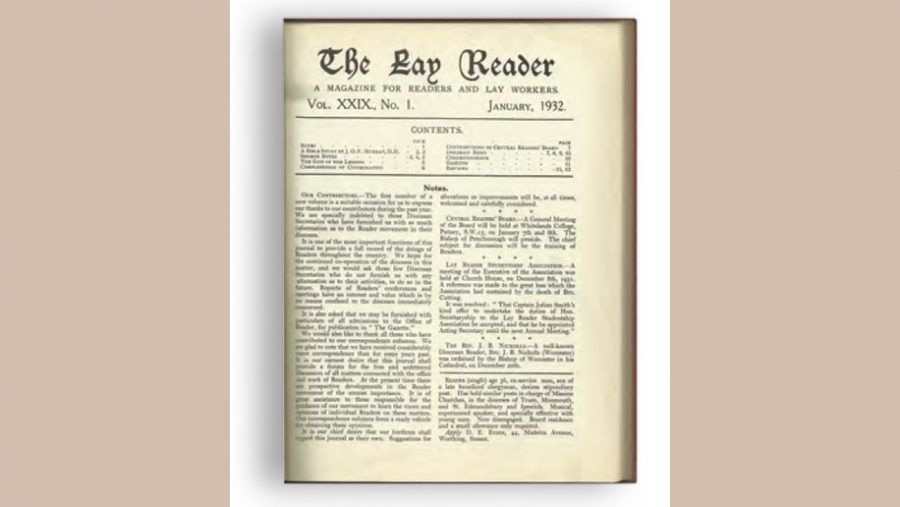
The Reader magazine for January 1932, which had no cover but was published once a month.
Correspondence pages reveal what people are concerned about and in May 1932 we discover a request for the publication of a history of the Reader movement. The writer, W.S Williams ‘Hon Sec of London R.B.’ says ‘The recent recognition of our movement by the Church Assembly marks an epoch of which it would be good to take advantage by spreading a knowledge of what the Reader office is and what Readers are doing.’ It was available at 2/- (two shillings) plus 4d for postage. At the end of his letter he helpfully adds that ‘the book contains information about respective health and unemployment insurance for Stipendiary and other paid lay-workers’. Someone who has already seen the book says he read it with ‘intense and sustained interest’ and hopes that ‘it will lead to a more willing recognition of (Readers) services’. Talking of books, later in the year we discover reference to the fact that in 1918 the Readers Board published a book ‘Teaching the Faith to Children’,price 1/6, postage 2p.
Each month has some sermon notes but again in May we see evidence of the presence of these being questioned. Frank Lipscomb from Shephall in the Diocese of St Albans writes: ‘Sir – I sincerely hope that “Sermon Notes” will be retained. I find them most helpful.’ He goes on to highlight the best one which he says is ‘a matter of the moment’, namely ‘Summer- Time Sunday’?! Some comments are less obscure: T Stevens Allen from Brighton says he ‘sincerely hopes that no change will be made in the range of matter, the arrangement of the material or in the format’. He points out that ‘The Sermon Outlines also should, I think, be retained as extremely useful to our younger brethren as well as to others. I consider the magazine, under its present editors, to be just perfect’. What more could you want as an editor? Anyway it seems that they kept ‘Sermon Notes’ as they are there at the end of the year although I am not sure what we would make of them today!
Reader ministry was not just about services as is often supposed. There are communications about ‘Visitations’, not of the archidiaconal kind but sitting and listening whilst having a cup of tea. (The Readers are of course referred to as ‘he’ as women were not admitted to Readership at the time.) J. G Harris of Oxhey observes that ‘there is no doubt that many of my Brethren would be able to deal competently and carefully.. with this work’, also suggesting that they may be more natural in the way they did it than the clergy!
Then there are those who are most close to my heart. Someone who calls himself ‘Countryman’ (pseudonyms seem to have been allowed) points out that some people do not seem to understand the problems associated with living in a rural parish. With no internet or Amazon, he complains that they find it hard to learn about modern movements ‘such as the Theology of Bart and the Oxford “Group” movement but have no means of getting proper communication’.
Finally I like the comment from the editor ‘We regret that we are obliged to holdover to the next month a number of letters’ because of the lack of space. Yes, I know all about pressure and prioritising contributions – and no internet communications will solve that one!
And then 60 years on in 1996
A couple of years ago someone gave me a small pile of The Reader magazine from the 1990s. These were A5, therefore smaller than in the 1930s, on poorer quality paper and with a floppy blue cover. Gone is the fashionable typography; the budget was obviously smaller. The editor’s wife supplied some line drawings and sometimes one of these appeared on the cover. However the contents are still very informative and again give us a picture of how Reader ministry was perceived and resourced.
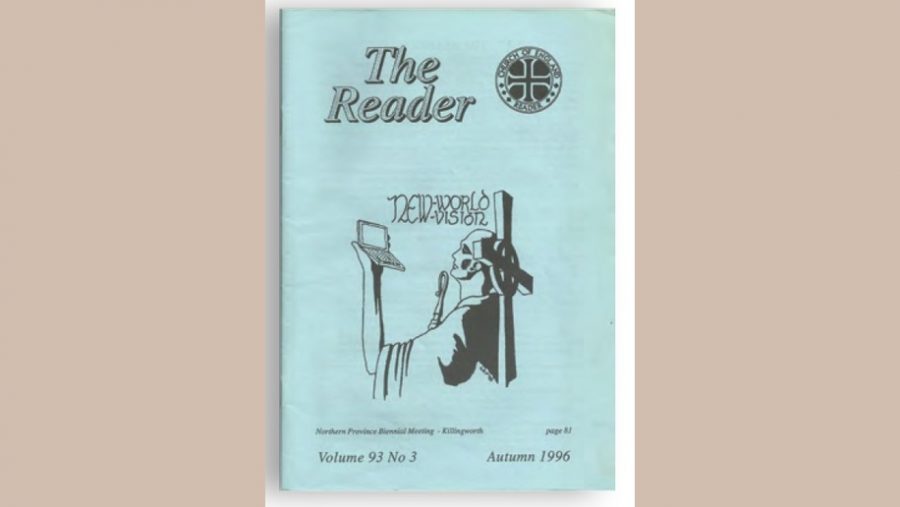
The 1996 version below, published once a quarter, is a smaller format, but does have an illustrated cover which was apparently drawn by the wife of the editor.
Looking at the content of Volume 93, no 3, I can see however a clear relationship between this and the magazine today and this issue which celebrated the 120th anniversary of the modern Reader movement. It has some of the same advertisers and feels fairly modern with someone selling sweatshirts with an embroidered Reader badge on it. (Or if you don’t fancy that, a fish or a dove motif!) There is also a Gazette and In Memoriam as well as some Book Reviews, but no Last Word.
In what I take to be the editorial, the first article entitled ‘New World- New Vision’, talks of the Northern Province Readers’ Biennial meeting at which it was said that Readers in the Victorian era were seen either as ‘of great use to the church’ or ‘were barred from preaching in consecrated buildings’. The article then goes on to warn of the danger of institutionalising the work of either lay or ordained ministries, making them too neat and organised. The picture was, it is claimed, more chaotic. Ministry ‘could not be seen as neat concentric circles but a series of encounters, not all of which were pointing to a central point’.
The next article is fascinatingly entitled ‘Reader Ministry in the 21st Century’. Most of the suggestions are fairly generalised but they all point to a broadening out of church centred ministry – taking services and preaching – to be more experimental and collaborative. There was obviously concern about what ‘post-modernism’ was and the author points out that ‘TV and film constantly blur the line between reality and fiction’. These were the days before the common use of the internet or the existence of social media, but we discover that at last The Reader was available on tape – at a cost – for anyone who was visually handicapped. Technology had begun to arrive!
A selection from the postbag shows us something of what Readers (no references to LLMs here – sorry!) were concerned about.’ ‘Is there a role for Readers in Chaplaincies?’ one asked. Another thinks that Readers are more clerical than the clerics. Most of the correspondents are men, but one women from the Diocese of Europe is disturbed by the phrase ‘Readers Rights’ asking ‘do we have any rights? Should we be demanding rights?’ She says she is after all part of the Christian church and, as a servant, she offers her service ‘where it is needed to the priest or to the laity.’ Yes, quite right; sensible woman!
Finally, and in common with the first issue of The Reader in 2016, there is an article about foot- washing (John 13:14), seeing it as the forgotten commandment. Well yes! The author goes on to say that this offered a practical way of true leadership form humility and service. Perhaps this is the message for us too…?
And into the twenty first century
With the millennium came radical changes. The size became A4, it was professionally designed and printed in four colours. The new concept was headed up by my predecessor, Clare Amos, who held the editorship from 2000 to 2007. Clare developed the magazine considerably during that time. She had a large number of contacts outside the Reader movement as she worked in the Anglican Communion office, and so there was a wider variety of contributors although not so many Readers. In 2007 Clare decided to seek fresh challenges and I took over in time to edit the last issue of 2007.
Gradually over the last nine years the magazine has evolved yet again. Our designer Kevin Wild and I were commended for making it more visually accessible, people have liked the covers (some of which are my own photographs) and many people have been very complimentary about the themes chosen and the scope of the articles generally. The number of articles actually written by Readers has increased considerably; in one recent issue we reached the maximum number of these so far, I think it was fourteen!
Finally, The Reader has a very young daughter! A Reader equivalent from South Africa saw our magazine and decided to start one for the church there. It is called The Levite, and I was privileged to contribute a short article in their first issue early this year.
Heather Fenton, Editor
[This article is from our Summer 2016 issue. To read back issues dating back to 2015, please activate your subscription]

Recent Comments