Oct 6, 2025 | News
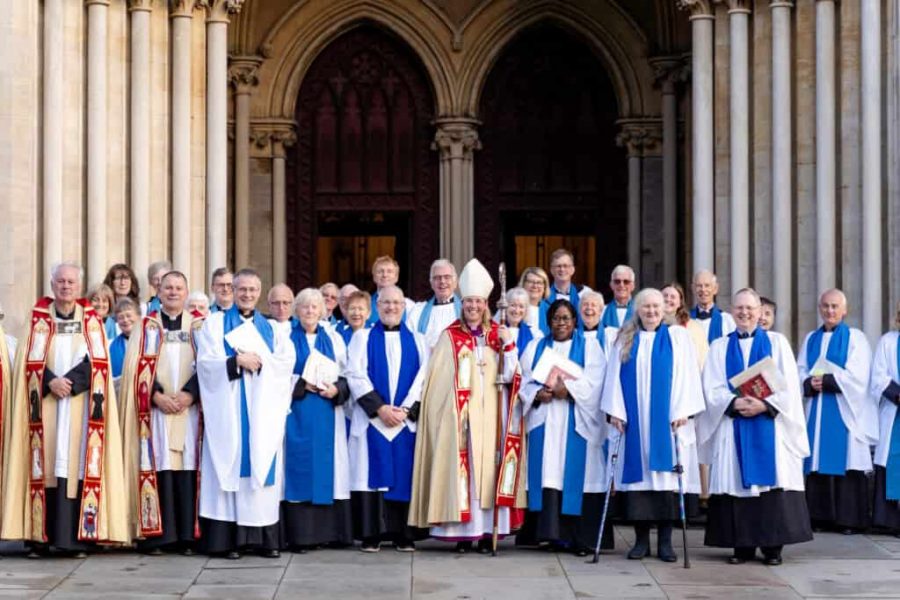
Ely’s service for licensing and admission of Licensed Lay Ministers (LLMs) took place on Saturday 4 October 2025.
There were seven newly licensed lay ministers – Anne Carter, Angela Deavall, Julie Hughes, Simon Kershaw, Stewart Piper, Raine Thorold and Trevor Webb.
To listen to their stories, click here
Five of the LLMs received the John Hullock Award – Fiona Davis, David Ogilvie, Nigel Smith, Tony White and David Williams,
Celebrating 25+ years of their ministry in the Diocese of Ely were Kate Aylmer, Malcom Barrett, Maria Dorman and Jan Payne. In addition, Cyril Dodd celebrated 45+ years of ministry, but was unfortunately not able to join us for the service.
Sep 28, 2025 | News
On Sunday 28 September, St Albans celebrated the licensing of six candidates to Reader ministry in a special service at St Albans Cathedral. The new readers were formally admitted and licensed in the service led by Bishop Jane, marking the beginning of their public ministry of preaching, teaching and pastoral care.
Family and friends of the new Readers, and supporters from across the Diocese gathered for the occasion. Hymns included Be thou my Vision and How Great Thou Art, with readings from two of the candidates, Dawn Kerridge and Simon Trundle, including the Gospel Reading from Matthew 18 featuring the reminder from Jesus’ teaching to have humble, child-like faith.
Reader Tom Otley from St Paul’s, Bedford, spoke at the service, sharing about the unique calling and opportunity that comes with being a Reader in the Church of England:
“Today is a day of celebration, a day that we can carry with us through the following months and years… [Being a Reader is] a great responsibility and great privilege.”
The congregation heard some stories from two Readers to give an insight into Reader ministry. Firstly Gillian Kern, Reader and Prison Chaplain at HMP The Mount, shared about her delight to serve as part of a multi-faith team at the prison, including leading worship and offering practical and pastoral support to inmates. Gillian shared that her greatest joy involved the positive change she sees in those individuals through the support they receive, and also of the peace of the Holy Spirit and a calmness which becomes so apparent in times of great challenge.
Bill Webb, who was one of the Readers licensed on Sunday, shared the story of what led him to Reader ministry:
“I came to belief later in life. Alongside starting to attend my local church in Leighton Buzzard, I went on a trip to Jerusalem and God started to do his work in me. Over the years, a succession of different vicars and curates at the church suggested that I might have a vocation but a lot of the time I pushed back on that. Eventually, I had to accept that God might have something for me, and here I am.”
Bishop Jane shared her thanks to all those gathered who are part of Reader ministry, past, present and future:
“The ministry of the Diocese is so much the richer for your ministries. So thank you for each and every way that you minister, whether that’s in a prison, a school, hospital, in a work place, in the church, or anywhere else, thank you for all that you give and all that you are.”
If you weren’t able to make the service, you can watch the recording here.
New Readers
- Sumitra Donaldson-Small: Leagrave, St Luke
- Barbara Doye: Wheathampstead, St Helen and St Peter
- Adrian Groves: Hitchin and St Paul’s Walden Team Ministry, St Mark
- Dawn Kerridge: Potton with Sutton and Cockayne Hatley, St Mary, All Saints and St John the Baptist
- Simon Trundle: Watford, St Luke
- William (Bill) Webb: Ouzel Valley Team Ministry, All Saints Leighton Buzzard
More photos available here
https://www.stalbansdiocese.org/news/admission-licensing-of-readers-september-2025/
Sep 27, 2025 | News
On Saturday 27th September, a special Readers licensing service took place. At this service at St Brides Church, James Fleming was licensed as a Reader.
This was a special and intimate service as James was the only Reader in the diocese to be licensed in 2025. As a result, it was decided to move the service from Liverpool Cathedral to St Brides, James’ own parish church to make the service more personal for James.
James studied part time over two years at Emmanuel Theological College and gained a Certificate in Theology, Ministry, and Mission validated by the University of Durham. James was joined by friends, family, Readers and the entirety of his own congregation at St Brides to celebrate this special occasion.
Along with James’ friends and family, Bishop Ruth carried out the licensing, with Archdeacon Miranda Threlfall-Holmes and Warden of Readers, Revd Mark Stanford both attending.
After the service, James spent some quality time with his congregation at St Brides to celebrate this special moment with hot cups of coffee and delicious cakes.
More photos here
https://liverpoolcofe.org/readers-licensing-service-2025/
Aug 12, 2023 | Extra Articles (For everyone), Features
When your vacancy eventually ends, the problems won’t necessarily all go away. Or they may be replaced by new ones. Timothy Lee encourages us to be flexible in our thinking.
[This article is from our Summer 2023 back issue. To read back issues dating back to 2015, please activate your subscription]
A new incumbent arrives – it’s a particularly difficult time for Readers or Lay Ministers. The new incumbent has so much to think about. The Reader’s needs may not seem all that important in the grand scheme of things. Often she or he has been virtually carrying the church in the vacancy. Suddenly we feel sidelined, and no-one seems to have noticed. It might look a bit like this.
Difficult adjustments
Clive has been a Reader for twenty years at St John’s, now licenced as Lay Minister. His preaching is respected. After a long vacancy, the parish now has a new young incumbent, Reverend Becca. Throughout the vacancy Clive and the other LLM, Sue, kept services going at St John’s, and found priests for eucharistic services. Clive looked after the family services. Sue took care of most of the others in the church as well as services in the local care home. Now Becca has arrived, she has taken the lion’s share of preaching. While Sue is content to work with the older people, Clive has found himself almost left out of the rota, preaching mainly at evensong. Then there is St Jude’s. St Jude’s is a traditional country church that the bishop asked Revd Becca to take on. Apparently they have not had a vicar for a long time and, the word is, they are ‘a bit of a handful’. Sue is alright about going there but Clive feels his place is at the main services at St John’s, as he is well known there. He is annoyed that Becca has barely mentioned his hard work in the vacancy, and she doesn’t seem interested in his ministry now. He doesn’t think she really understands the way they do things at St John’s. She seems really slow to get going as well. He has been talking to people about her and several seem to share his concern.
From another viewpoint
Let us take a look at the situation from Revd Becca’s perspective. She had a wonderful time as a curate, and couldn’t wait to get her own parish. St John’s shows great promise for family services – numbers have grown since she arrived. Apart from Clive, most of the leadership team are very supportive of her. Her old incumbent told her just to listen and observe for the first six months, and try to really understand things before making any big changes. The bishop asked her to take on St Jude’s because of a reorganisation. Apparently there was a problem with their previous vicar – many people there seem still to be very hurt by what happened. St Jude’s seems to demand a lot of her time and prayers. But St John’s is the town church with many young families, so it will have to take priority. After four months, Becca feels she is only just beginning to understand the scale of task confronting her. It is so very different from being a curate. But she has just started on the diocesan incumbency training course, and she now has a peer group of other new incumbents to share ideas with. She has two Lay Ministers. Sue is a dream, so helpful, she has been down to St Jude’s, bringing love and calm. What a blessing. Clive … well – he only wants to preach at St John’s. He really seems to have a high opinion of his own preaching – but his gifts are really not with young families. He would probably be fine at St Jude’s. But he seems contemptuous of their faith and tradition, and refuses to go. Apparently he is stirring up trouble with a few of his friends. We seem to be having problems all round! So how might things have been different?
Imagine if …
What if when Revd Becca arrived, Clive had noticed her style was different – how, he wonders, does she ‘tick’? We can understand more about personalities through Myers Briggs, the Enneagram or the Insights colours:
- ‘Fiery Red’ people are positive, assertive, decisive, deal quickly with the present situation.
- ‘Sunshine Yellow’ – are creative, social, expressive and have masses of ideas.
- ‘Earth Green’ – are calming, sharing, patient, focus on caring and growing relationships.
- ‘Cool Blue’ – are cautious, analytical, use logic, plan things carefully, and think before they act.
You can view more on Insights colours on YouTube.
But we have to understand ourselves first. How well do you know yourself? How do others see you?
For by the grace given to me I say to every one among you not to think of himself more highly than he ought to think, but to think with sober judgement, each according to the measure of faith that God has assigned. (Romans 12: 3).
Becca is clearly different from the last incumbent. Clive decides to pray for her. He begins to notice her strengths, her gifts. She is attracting new families to the family service. Her preaching is actually not bad. She seems to know what she is doing. He arranges a meeting with her. He talks about the vacancy and his working agreement, and what he likes doing best. She listens patiently. She explains her priorities – and about St Jude’s. That is quite an eye opener for Clive. Sensing the need, he offers to go and preach there. When he goes there, he is warmly welcomed – to his great surprise – and his sermon goes down well. After a few weeks of this he begins to realise they do indeed have a faith, perhaps more often expressed in deeds rather than words. He gets a book on rural ministry and starts to understand them a bit more. Clive and Becca work together on a plan to restore confidence at St Jude’s. Becca really appreciates his contribution; at the same time Clive is sensing a new direction in his ministry.
- Let me hear in the morning of your steadfast love, for in you I trust.
- Make me know the way I should go, for to you I lift up my soul. (Psalm 143: 8).
A new incumbent can bring huge challenges to Readers and LLMs. Our needs may not be top priority in the great scheme of things, but our ministry and gifts are valued more than we may realise. The first need for Readers and LLMs in this is prayer, openness and positive engagement – not moping on the sidelines. At such times we stand at a crossroads in our personal journey: where is God calling us now?
Timothy Lee is an LLM (Reader) in Chelmsford Diocese.
Apr 12, 2023 | Extra Articles (For everyone), Features
[This article is from our Summer 2023 back issue. To read back issues dating back to 2015, please activate your subscription]
Alan Stanley puts forward a vision for the future.
There are, of course, many models for lay-led churches. The question for Anglicans and others with either episcopal or an equivalent ecclesiology is how to develop a lay led church without resorting to a congregational model.
As we mature, we add experience to the original ‘deposit of faith’ and it changes us – changes how we think, speak, act and pray. We learn that faithfulness does not involve circling the waggons to defend our position against attack, but willingness to step out ‘beyond’, following the God who goes before us.1
Let us take an imaginary parish church, All Saints, which is without an incumbent.
A confident congregation
The diocese is one with a wealth of lay training which All Saints has benefited from over many years. It has a couple of people who are confident to lead a home study group, an informal pastoral care group which also looks after bereaved people, and a reasonably resourced but small group of people who love working with children and young people. A few people from All Saints have attended diocesan courses which have led to them being authorised as pastoral assistant, worship leader and occasional preacher, and there is in place one Licenced Lay Minister and one in training.
The diocese has also provided training for churchwardens, PCC secretaries, intercessors and church treasurers, all of which the various post holders have attended. Since the last incumbent left, the churchwardens have held monthly meetings with the other PCC officers, the LLM, children and youth leader and the pastoral assistant. This group has provided leadership on day-to-day matters with the more strategic decisions being discussed by the PCC. The churchwardens have been able to consult the area dean and the archdeacon for matters which are either beyond their remit or on which they need guidance. Services of Holy Communion, baptism and marriage have been arranged with local or diocesan clergy through a contact list provided by the diocese. Funerals have mostly been taken by the LLM.
The All Saints’ congregation is used to having a service of Holy Communion on two Sundays each month, their previous incumbent being shared with another parish. With the support of the lay worship leader, occasional preacher, the All Age Worship team and the LLM, this pattern of needing a visiting priest to take Communion services, along with baptisms and weddings, was sustainable. The congregation was understanding if visiting clergy could not be found for two Sundays a month and were happy to drop to one Communion a month when necessary. Permission has just been granted for the LLM to take a Public Worship with Communion by Extension service when a priest cannot be found.
The work of the pastoral visitors continues, and the pastoral assistant convenes regular support meetings, as do the children and youth team leader. The worship leader and occasional preacher have been meeting for some time as a small peer support group convened by the LLM, and the home study group leaders join the leadership group once a term to discuss the direction the group should take.
The diocese runs a Leading Your Church into Growth course, and the archdeacon has invited All Saints to send two members to the next one. Two volunteers have been found, and the church is gradually adopting their suggestions.
All Saints has not ended up in the happy position of being able to sustain its own life by chance. Its previous incumbent knew that one day she would leave, and that cuts in diocesan budgets meant she would probably not be replaced by an equivalent minister, so she had planned and worked for the time when the church would have to be self-sufficient.
What is missing from the life of All Saints? It has a connection with the wider Church through the area dean, archdeacon, and visiting clergy. It is nourished by episcopal ministry through the support provided by the diocese for its wide variety of ministries. Its ministry is episcopally controlled. This is primarily through the churchwardens, who are officers of the bishop. The bishop’s oversight is strengthened in depth through episcopal authorisation of the pastoral assistant, worship leader and occasional preacher and the licensing of its LLM. The saints are in effect equipped for their ministry by the work of the bishop through the diocesan training team, so are truly an episcopally-led church, which is fulfilling the injunction in Ephesians (4: 12–13).
Challenges
However, All Saints does face a number of challenges. The duties and responsibilities of the churchwardens are enshrined in law and are very wide ranging (one diocese lists eighty-three of them in its guidance to wardens!)2 and it is not clear that anyone will be willing to take on the load when the current wardens retire. The PCC had been hoping to install screens so that printed service material could be reduced, and to replace the pews with chairs so that the nave could be used for community activities as well as worship. However, the difficult and lengthy process to get diocesan approval for these changes, plus the potentially heavy legal consequences if the church does not follow the procedure accurately, has placed something of a dampener on these ambitions.
One of the biggest challenges that the PCC faces is in moving from a hierarchical pattern of leadership to a flat and collaborative one. Everything that it has experienced so far in the church has been predicated on the pyramid model, including the previous incumbent’s work to make the church self-sustaining. One of the churchwardens is an entrepreneur who has successfully founded and grown a number of small businesses using a flat management model. This, she found, really helped everyone in the business to feel deeply involved and confident to work passionately and with minimum supervision in their own particular area. She is acutely aware that some of the most successful companies like Amazon and Google have this sort of flat management system. She would like to introduce this model to the life of the church but feels frustrated at the constant clashing with the pyramid model where every initiative has to be sent up the line for approval. This recently came to a head in discussion with the diocese about the screens, pews and chairs, when the overwhelming sense was that some remote level in the pyramid would need to make decisions which, in her experience, should be made at local level.
She is aware that in her many years in the commercial world, management and leadership patterns have changed over time. When she ran her first business, she was the boss, and everyone did what she decided. The lessons she learnt from the bursting of the dot.com bubble in the mid 1990s totally changed her subsequent leadership style. She moved her business from what she now thinks of as a dead-handed majestic monolith into small, nimble units that could respond rapidly to changing opportunities. She abandoned the old organisational charts and replaced them with interaction charts. Most of the more successful companies that she did business with had also recognised the many disadvantages of the pyramid structure. This made working with others much more creative.
The contrast between her working environment, where good communication, making friends not enemies, innovation and reinventing the way people work together produced team commitment and dedication, and how as a churchwarden she is required to relate to the diocese and the parish is huge. She will not be disappointed when her term of office ends.
Afterword
All Saints has been operating (in my dreams) as a lay-led church for five years now. The leadership team consists of two wardens who between them keep an eye on fabric and finance, a member for each of the children and youth teams, the pastoral visiting and worship leader’s teams and the Reverend Sue. Sue is a self-supporting minister who, in return for free housing, gives the equivalent of two days plus two Sundays a month to the parish. Sue has been given a brief by the whole team to spend time praying and being available for people. She has been asked to keep her parish diary as light as possible.
Sue has found that she is often approached by people from both the congregation and the community for advice and prayer. Numbers in the fellowship groups and Sunday services have been gradually rising. The leadership team believes that growth through relationships has happened as a direct result of the leadership, and through it the whole church, being relational not hierarchical. The most important incremental decision facing the leadership team now is how to refresh its membership without losing the trust that has developed between them.
The fundamental question which All Saints seems to have answered in a pragmatic way, is ‘Is the church defined by her ordained ministry or the ordained ministry defined by the church?’ Vatican II points us to the latter by designating ministry as service. The Roman Catholic theologian Peter Neuner pithily points out the implications of this:
A service can be defined only in the light of that which it has to serve, for the sake of which it is there. That means that the ministry is defined in terms of the church, and not the church in terms of the ministry.3
All Saints has defined the ministry of leadership in terms of its whole community, not in terms of one ordained person. Will the Church of England ever have the courage to follow the aptly named All Saints?
Alan Stanley is an LLM in the Elmete Trinity Benefice, Leeds Diocese. He is also a part-time prison chaplain.
References
- J P Williams, J P, Seeking the God Beyond: A Beginner’s Guide to Christian Apophatic Spirituality. London: SCM Press, 2018, p.42.
- Lichfield, accessed at: https://ecclawsoc.org.uk/wp-content/uploads/2017/10/Churchwardens-Induction-Handbook-2017.docx
- Neuner, P, ‘Ministry in the Church: changing identity’. In: Kerkhofs, J (ed) Europe Without Priests? London: SCM Press, 1995, p.130.

Recent Comments