Oct 6, 2025 | News
Ely’s service for licensing and admission of Licensed Lay Ministers (LLMs) took place on Saturday 4 October 2025.
There were seven newly licensed lay ministers – Anne Carter, Angela Deavall, Julie Hughes, Simon Kershaw, Stewart Piper, Raine Thorold and Trevor Webb.
To listen to their stories, click here
Five of the LLMs received the John Hullock Award – Fiona Davis, David Ogilvie, Nigel Smith, Tony White and David Williams,
Celebrating 25+ years of their ministry in the Diocese of Ely were Kate Aylmer, Malcom Barrett, Maria Dorman and Jan Payne. In addition, Cyril Dodd celebrated 45+ years of ministry, but was unfortunately not able to join us for the service.
Sep 28, 2025 | News
On Sunday 28 September, St Albans celebrated the licensing of six candidates to Reader ministry in a special service at St Albans Cathedral. The new readers were formally admitted and licensed in the service led by Bishop Jane, marking the beginning of their public ministry of preaching, teaching and pastoral care.
Family and friends of the new Readers, and supporters from across the Diocese gathered for the occasion. Hymns included Be thou my Vision and How Great Thou Art, with readings from two of the candidates, Dawn Kerridge and Simon Trundle, including the Gospel Reading from Matthew 18 featuring the reminder from Jesus’ teaching to have humble, child-like faith.
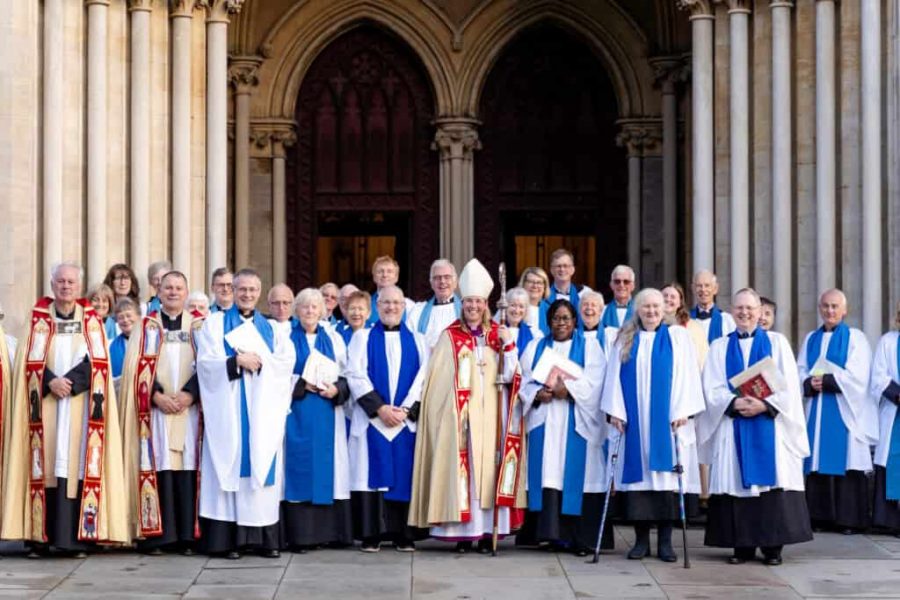
Reader Tom Otley from St Paul’s, Bedford, spoke at the service, sharing about the unique calling and opportunity that comes with being a Reader in the Church of England:
“Today is a day of celebration, a day that we can carry with us through the following months and years… [Being a Reader is] a great responsibility and great privilege.”
The congregation heard some stories from two Readers to give an insight into Reader ministry. Firstly Gillian Kern, Reader and Prison Chaplain at HMP The Mount, shared about her delight to serve as part of a multi-faith team at the prison, including leading worship and offering practical and pastoral support to inmates. Gillian shared that her greatest joy involved the positive change she sees in those individuals through the support they receive, and also of the peace of the Holy Spirit and a calmness which becomes so apparent in times of great challenge.
Bill Webb, who was one of the Readers licensed on Sunday, shared the story of what led him to Reader ministry:
“I came to belief later in life. Alongside starting to attend my local church in Leighton Buzzard, I went on a trip to Jerusalem and God started to do his work in me. Over the years, a succession of different vicars and curates at the church suggested that I might have a vocation but a lot of the time I pushed back on that. Eventually, I had to accept that God might have something for me, and here I am.”
Bishop Jane shared her thanks to all those gathered who are part of Reader ministry, past, present and future:
“The ministry of the Diocese is so much the richer for your ministries. So thank you for each and every way that you minister, whether that’s in a prison, a school, hospital, in a work place, in the church, or anywhere else, thank you for all that you give and all that you are.”
If you weren’t able to make the service, you can watch the recording here.
New Readers
- Sumitra Donaldson-Small: Leagrave, St Luke
- Barbara Doye: Wheathampstead, St Helen and St Peter
- Adrian Groves: Hitchin and St Paul’s Walden Team Ministry, St Mark
- Dawn Kerridge: Potton with Sutton and Cockayne Hatley, St Mary, All Saints and St John the Baptist
- Simon Trundle: Watford, St Luke
- William (Bill) Webb: Ouzel Valley Team Ministry, All Saints Leighton Buzzard
More photos available here
https://www.stalbansdiocese.org/news/admission-licensing-of-readers-september-2025/
Sep 27, 2025 | News
On Saturday 27th September, a special Readers licensing service took place. At this service at St Brides Church, James Fleming was licensed as a Reader.
This was a special and intimate service as James was the only Reader in the diocese to be licensed in 2025. As a result, it was decided to move the service from Liverpool Cathedral to St Brides, James’ own parish church to make the service more personal for James.
James studied part time over two years at Emmanuel Theological College and gained a Certificate in Theology, Ministry, and Mission validated by the University of Durham. James was joined by friends, family, Readers and the entirety of his own congregation at St Brides to celebrate this special occasion.
Along with James’ friends and family, Bishop Ruth carried out the licensing, with Archdeacon Miranda Threlfall-Holmes and Warden of Readers, Revd Mark Stanford both attending.
After the service, James spent some quality time with his congregation at St Brides to celebrate this special moment with hot cups of coffee and delicious cakes.
More photos here
https://liverpoolcofe.org/readers-licensing-service-2025/
Dec 16, 2024 | Extra Articles (For everyone), Features
Ministering from the space between
Ben Martin encourages us to understand that being ‘lay’ is not second best or a vocational ‘waiting room’, but an important calling in itself.
[This article is from our Winter 2024 back issue. To read back issues dating back to 2015, please activate your subscription]
On March 27th, 2014, I was sitting in my living room in Chesterfield fighting back tears after the phone call came from the Assistant Diocesan Director of Ordinands. The letter from my Bishops Advisory Panel had come back, and it was a ‘not recommended’. He couldn’t understand it, and neither could I. Trying to explain this to my wife was heartbreaking. I had felt a call to the Church of England at 19 years old, and this was the path! She had left her church tradition to support me as I discerned my vocation, and I had failed.
Ten years later, almost to the day, and I was licensed as a Licensed Lay Minister (Reader); four months into my new role as Lay Ministries Officer for the Diocese of Derby.
So, what changed? Well, as is typical of the way in which the Holy Spirit works in our lives, it not only took time but a series of events which gradually shifted the way in which I think not only about vocation, but also about ministry and the Church of England.
The Company of Pioneers
When I first moved to the Diocese of Derby in September 2012 it was to begin working for and with The Order of the Black Sheep, one of the first twenty Bishops’ Mission Orders. Reverend Mark Broomhead, who was leading the community, invited me to join him at a gathering of pioneers from across the diocese, known as the Company of Pioneers. The make-up of the group was primarily ordained, with just two lay people: myself, and a Church Army officer. This company had a shifting membership especially with curates coming in and out, but one thing remained the same: from 2012 until it stopped gathering during the pandemic, I was the only lay member without a licence.
Something else remained the same, however: an attitude, specifically, my acceptance by ordained colleagues. None of them looked down on me, or thought that my voice was less valuable because of my lay-ness (or my age!). They genuinely valued me, listened to what I had to say, and encouraged my ministry. There was difference between us, but not that of superior knowledge or experience. It was a difference that settled me. I felt at home, not because I was with people I wanted to be like, but because I was with fellow ministers who held a particular sense of sacramental call.
I battled with my desire to be ordained. What was it about sacramental ministry particularly which so captivated me? The conclusion I came to was this: Why am I not allowed to do that?
Liminal space
As I moved away from Chesterfield towards the north of the diocese to Derby towards the south, I became increasingly interested in liminality and its interaction with theology and my own emerging understanding of Anglican ecclesiology. I tend to describe liminality as ‘the space between spaces’. The origin of the word comes from the Latin ‘limen’, meaning ‘threshold’. As a result, I grew fascinated by the narthex (entrance porch) of St Alkmund’s, the church where I was working. I recall standing in the middle of it; out of the corner of one eye I could see through the glass doors towards the estate opposite, and out of the corner of the other eye I could see the cavernous space we call the ‘worship area’, with the huge communion table on the dais. This physical space, between the wider community and the worshipping community, felt to me like home, albeit a slightly uncomfortable one.
We moved our Sunday evening service into this space as a symbolic gesture that we were not to be shut away, but that our worship took place on the threshold, the space between ‘the church’ and ‘the world’. It was in that space where we discovered the Spirit-filled discomfort of the inbetween. Silence was interrupted with noise (and occasionally police sirens), unexpected friendships began, and new people joined.
We eventually outgrew the narthex, so I made the decision to move back into the worship area. Looking back, it was a shift to comfort. We tried to make the space feel different with big umbrellas, gazebos and lights, but the consequence was a separation between those who felt more affinity with one space than the other. And, as ought to be expected, the ‘inherited’ won out.
The young lads who had been coming effectively became a youth group in the hall on the other side of the church, becoming separate from the worshipping community.
It was easy to see how people struggled to exist in that liminal space, on the threshold between ‘the world’ and ‘the church’, but increasingly I found myself needing to lead in that space, and encourage others to occupy it with me. Not presiding at the communion table, but dwelling in the space between church and world. The space which the laity occupy.
Contentment and identity
The Church of England is a clerical church. Or is it? I want to argue that we must rethink the narrative of our ecclesiology. Unfortunately, this argument can often be misinterpreted as an attempt to undermine the three-fold order of ordained ministry: Bishops, Priests (Presbyters), and Deacons. This is far from the truth. I absolutely affirm this order – I wouldn’t be an Anglican if I didn’t! However my concern with the narrative is that the threefold order of ordained ministry has become something for people to aspire to. As it had become for me.
The nature of being lay – a common member of Christ’s body – felt, for me, not enough. I wanted to be more. However, the vocation journey for me so far has been one of realisation. Realising that my discontentment with being lay was not a call from God, but a practical response to a social phenomenon, I began to understand that vocation to ordained ministry was not a higher call, simply a different and distinct one. To be distinctively lay, which by virtue of our mutual baptism we are, means to be distinctively Christian. The call of the Laity is not to aspire to ordination, but to be the people of God in the world, seeking His kingdom first, sharing in the prophetic, priestly, and kingly ministry of Christ. And our call as Readers is to be leaders, teachers, and enablers from that place.
When we preach, not from chairs or pulpits but from the lectern, it is a privilege. We stand in a place that our ordained colleagues cannot, in the fullness of our persistent calling as ordinary people of God, with the ordinary people of God. Lay is not a vocational waiting room, for it is in the ordinary places and spaces where the Holy Spirit moves, waiting for us to join in. As we, as lay ministers of all shapes and sizes teach, enable, and lead, may we do so in the confidence that Christ has not called us to second best but has called us to the richness of our current vocation.
Ben Martin is an LLM and Warden of Lay Ministries in Derby Diocese, and a member of the CRC Advisory Group.
[This article is from our Winter 2024 back issue. To read back issues dating back to 2015, please activate your subscription]

Recent Comments