Feb 18, 2026 | News
As you can read elsewhere on the site, The Reader magazine has been in existence for a very long time, certainly over 100 years, under various titles such as ‘The Lay Reader: a magazine for Readers and Lay Workers’.
Celebrating The Reader magazine
What is certain is that over that time there have been both new and familiar challenges for lay ministry and lay ministers, and the magazine – and now website – seeks to help in its mission of ‘Equipping, challenging and transforming’ your ministry.
To that end, we have put together a reader survey to see what you think of the magazine and website, and what you would like to read in the future.
The link for the survey is here
https://www.surveymonkey.com/r/GTYGM5S
Please do take the time to complete the survey and give us as much detail as possible when it comes to suggestions – there are several comment boxes you can type into.
We are here to serve, and wish to do so based on as many replies as possible.
I should also say that I welcome ideas for articles, and contributions as well – you can reach me at editor@transformingministry.co.uk
Tom Otley
Feb 9, 2026 | News
For many months, representatives from the national church, the Central Readers Council (CRC) and lay ministers have been shaping an update to the Bishop’s Regulations for Reader Ministry. These Regulations were published in 2000 so needed some considerable updating to reflect changes in ministry over the last quarter of a century. The new guidance has now been accepted by the House of Bishops and commended to dioceses.
For most Readers and Licensed Lay Ministers (LLMs), little will change. We remain licensed under canons E4–6; we still preach, teach, lead worship, offer pastoral care and serve missionally; and safeguarding continues to be essential. Many Readers/LLMs have ministries both inside and outside the church. However, the updated guidance clarifies certain issues:
Retirement
The 2000 regulations required Readers over 70 to surrender their licence and apply for “permission to officiate” instead. The 2026 guidance removes this automatic distinction, stating simply that a licence “may continue after their 70th birthday.” It also emphasizes that Readers should not feel obligated to continue indefinitely and recommends that dioceses consider writing retirement policies for Readers/LLMs. (See section 5 and para 3.4.)
Emeritus status
Dioceses have diverged in practice over the use of the term ‘Emeritus’. The 2026 guidance states that those with Emeritus (or Emerita) titles are retired from active ministry and should not robe. (See para 5.5.)
Discernment and Formation
The 2026 guidance introduces references to the national discernment framework exploring specific areas (love for God, call to ministry, love for people, wisdom, fruitfulness and potential) and national formation framework. It also emphasizes diversity, inclusion, and accessibility in discernment processes, with national funding available for disabled candidates or those with additional learning needs. (See section 2.)
Safeguarding
As expected, safeguarding requirements have been significantly enhanced since 2000. Readers/ LLMs are expected to update their training appropriately, and in a timely manner. Failure to do so may cause their licence to be revoked. (See section 3 especially para 3.10, and para 2.9.)
Ministerial Development Reviews
There is an increased emphasis on written agreements for Readers/LLMs with continued development and training linked to Ministerial Development Reviews. The 2026 guidance is more detailed about what reviews should cover, including consideration of retreats or sabbaticals. (See paras 4.6 and 4.7)
Scope of Licence
All Readers/LLMs hold licences which allow them to preach and lead worship within their diocese with their incumbents’ permission and the permission of the receiving incumbent. However, the majority of Readers/LLMs have a named parish or benefice on their licence where their ministry is focused. The new guidance explicitly mentions the possibility of licensing Readers to a diocese or deanery rather than a benefice or parish, providing greater deployment flexibility. (See para 3.7.)
Working in Two (or More) Dioceses
Occasionally Readers/LLMs are invited to preach, lead worship, or take a funeral in another diocese. They may do so but must first obtain written permission from the bishop of the other diocese. If a Reader/LLM regularly works in two dioceses, they may hold a licence in both dioceses. (See paras 3.8 & 3.6.)
Vacancies
The 2026 guidance is more nuanced about Reader ministry during clergy vacancies, noting that ‘continuation’ should not be assumed indefinitely during protracted vacancies, and setting clearer expectations for new incumbents to foster collaborative ministry. It also recognises that prolonged vacancies can add a strain to Readers/LLMs and that their wellbeing and ongoing sense of call should be actively monitored rather than taken for granted. (See paras 4.21 & 4.22.)
Funerals
The new guidance confirms that Readers/LLMs may conduct funerals with the Bishop’s authorisation and appropriate training. The earlier regulations stated that Reader/LLM ministry was ‘voluntary’ and, for some ministers, this was very important. However, since 2014, dioceses have been able to authorise payment to Readers/LLMs for funerals. The guidance clarifies this, although this is still at the discretion of the individual diocese and Readers/LLMs may always decline payment! (See paras 4.10 & 4.11)
Public Worship with Communion by Extension
This is a new development since the original Regulations were approved. Some dioceses allow Readers/LLMs to lead such services; others do not. The new guidance acknowledges this possibility. (See para 4.9).
The CRC (Central Readers’ Council)
It is good to see that the CRC is acknowledged as the charity supporting Readers/LLMs in England. (Since this new document is published by the Church of England, it applies only to England although the Church in Wales has been given a copy. The CRC also oversees Readers/LLMs in the Church in Wales. See p.2)
Finally, the new document uses the phrase ‘Reader / LLM (Reader)’ throughout. While admittedly clumsy, it reflects the use of both names in the Church of England after the decision (in 2008) that Licensed Lay Minister (Reader) may be an alternative title for Reader.
Dioceses have been sent this guidance and asked to consider it over the next two years in their development of Reader/LLM policies. Hence there may not be instant changes, but it is hoped that more consistency will develop across the Church of England in its recognition of Reader/LLM ministry.
We are grateful to everyone who has contributed to this guidance which aims to be encouraging and supportive.
Dioceses will seek to communicate any relevant changes to their Readers/LLMs over the next two years.
The guidance can be found at Reader LLM Guidance 2026 or the CRC website.
If you have any comments or questions about the new guidance, please leave them below
Nov 2, 2025 | News
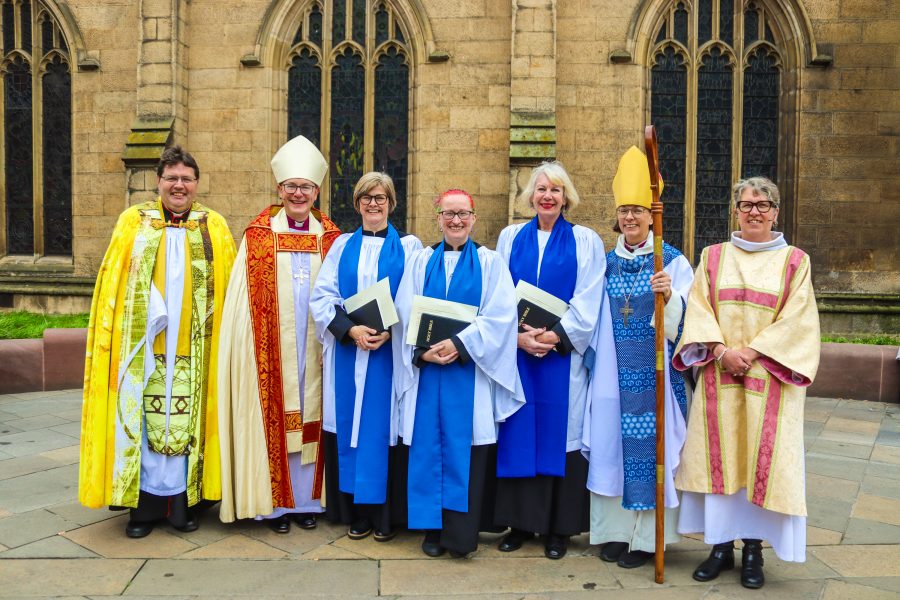
Six candidates were licensed for lay ministry at the annual service for Licensed Lay Ministers at Christ Church Cathedral on Saturday.
Alongside the newly admitted ministers were licensed lay ministers (LLMs) from around the diocese who joined the candidates in dedicating themselves afresh to their ministry, during the service which was led by Bishop Gavin.
The candidates presented were Eve Hitchens, Linda Hobbs, Rachel Moss, Mike Murray, Joe O’Neill and Karen Broadbent.
The preacher was the Revd Andrew Blyth, Director of Mission and Ministry at the diocese. During his sermon he celebrated the candidates as they begin a new chapter of their story. Evoking the imagery of The Archers and The Traitors (!) Andrew described us all as living our own story.
He said: “God writes the story in us and with us. Let him, I pray. A story of hope and goodness fill each one of us with this hope in Jesus’ name.”
During the service each of the candidates were asked to publicly to profess their faith with the congregation as their witness. Bishop Gavin then admitted each of them in turn, presented them with a Bible and prayed for them.
Following this prayer the LLMs’ sponsoring training incumbent or archdeaconry advisor then put the blue scarves on them. At the end of the service, all of those licensed or authorised to preach stood, and holding their Bibles aloft were blessed in their ministry.
- Eve Hitchens will serve at St Michael in the Northgate, Oxford.
- Linda Hobbs will serve at St Helen’s in Abingdon.
- Rachel Moss will serve at St Michael and St Mary Magdalene, Easthampstead.
- Mike Murray will serve at St Michael’s Steventon.
- Joe O’Neill will serve at St Mary’s Church, Aylesbury.
- Karen Broadbent will serve at Christ the King, Sonning Common.
See more photos from the service in the Facebook gallery.

Recent Comments