
Michael Green by his friends  

Michael Green
by his friends
Author Julia Cameron (ed.)
Publisher IVP £16.99
Format hbk
ISBN 9781789741148

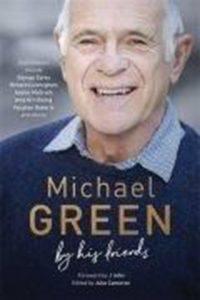
Michael Green, who died last year, was a man of rare gifts. An evangelist, a scholar, a priest, a writer of apologetics and a leader in Anglican charismatic renewal, his influence, like that of his contemporaries David Watson and John Stott, has helped to change the church. This collection of essays takes us through all of his life, illustrating how being a faithful minister was costly to him and his family. He was a man who was infectious in his love for his Lord, giving out copies of his evangelistic books as he lay in hospital in his final weeks. The influence he had on evangelists was impressive – he wanted evangelism to appeal to both the head and the heart. He was a mentor to Britain’s best known evangelist, J John, who writes movingly about Green’s influence on his life in the foreword. Green was a man of great contradictions – humble, yet sometimes so determined that he did not fully listen to the concerns of others.  True saints often do have clay feet but, if they are obedient to their Lord, they can achieve much in the power of the Holy Spirit.

CAVAN WOOD

Biographical Tributes


Preaching Women

Preaching Women
Author Liz Shercliff
Publisher SCM £16.99
Format pbk
ISBN 9780334058380

An ambitious book – asserting that (and why) women preachers need to find their voices as women, and how to go about it. It also includes a chapter on hermeneutics, one on hearing Bible women, a method of how to construct a sermon, sermon excerpts and questions for reflection, all in 168 pages. Much of it, e.g. the contention that women preachers are heard differently by virtue of their gender, and its implications, I found convincing; we do need a book (or more) on women preachers. Some of it, e.g. the chapter on hermeneutics, read like lecture notes. I tried the ‘method’ described in the penultimate chapter, which takes as sermon sources an awareness of experience, position, culture and tradition, and it led to a useful gathering of the building blocks of my sermon. I share some of the author’s experiences of patriarchy but not others, and to get the most out of the book, it might best be read and discussed by a group of women preachers, with maybe even a man present? I dislike the cover: lots of different smiling young women and not one grey hair, which is a form of sexism in itself.

GERTRUD SOLLARS

Feminism, Preaching


Unorthodox: LGBT + Identity and Faith

Unorthodox: LGBT + Identity and Faith

Author Sean Richardson (ed.)
Publisher Five Leaves £7.99
Format pbk
ISBN 9781910170601

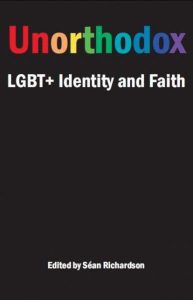
This book contains stories of fourteen people, all based in Britain, with a commitment to their own religious tradition and/or their relationship with God. They also share ‘unorthodox’ sexual or gender identities. They are lesbian, gay, bisexual or transgender – but many prefer to describe themselves as ‘queer’ – originally an abusive term for homosexual men but now used by people about themselves to signal their acceptance of being a sexual outsider. Their religious backgrounds vary – Hindu, Sikh, Muslim, Jewish and Christian; but their stories have common themes. The struggle to accept an unorthodox nature often leads to depression and/or struggles to be ‘normal’ due to internalised hostility to queer people in their ‘orthodox’ communities. For those from ethnic minorities, racism and having a religion and culture also ‘unorthodox’ in the UK made their search for their true selves harder. And they all know that true self cannot ignore God or religion. This book tells how God does not abandon those who seek, from whatever nation, tribe, people or language – and however queer we are.

PETER D TOON

Inclusion


The Diaconate in Ecumenical Perspective
The Diaconate in Ecumenical Perspective

Author D. Michael Jackson (ed.)
Publisher Sacristy  £19.99
Format pbk
ISBN 9781789590357

This volume resulted from a 2011 ecumenical conference on the diaconate at the University of Regina, Canada, and includes chapters on the theology of the diaconate, the transitional diaconate, women deacons, ecumenical perspectives on the diaconate, the prophetic and liturgical roles of deacons and diaconal formation. The book’s broad ecumenical range makes it unusual, with contributions from the Anglican, Roman Catholic, Ukrainian Catholic, Lutheran and Methodist traditions; in addition, authors address the diaconate in the Orthodox and Oriental Orthodox Churches. The 19 chapters are succinct, but make a compelling case for ecumenical engagement on a ministry shared between the Churches but often interpreted in very different ways. Nevertheless, a common thread running through many chapters is the importance of John Collins’ theology of diakonia as more than just service. The chapter on the survival of women deacons in the eastern Churches, in particular, illuminates an often overlooked and forgotten history. A weakness of the book, which will undoubtedly diminish its academic impact, is the regrettable absence of detailed references for most chapters, a bibliography and an analytical index.

FRANCIS YOUNG

Ecumenism, Ministry


The Meeting That Changed the World

The Meeting That Changed the World

Author Michael Knowles
Publisher Sacristy  £17.99
Format pbk
ISBN 9781789590265

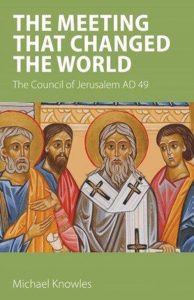
The argument of this book is that the Council of Jerusalem in AD49 as outlined in Acts has been underestimated. Whatever detailed negotiations led up to its conclusions, it liberated pagan Christian converts from needing to follow the full rigours of the Torah. This traumatic but necessary step changed Christianity from being a local sect into a world-transforming faith. The author, a Roman Catholic, uses this model to challenge his own Church: if it is not prepared to ordain women and accept other similar reforms, its numbers will continue to decline. He is thus revealed as the kind of Vatican II-affirming Catholic who would be sympathetic to the present Pope. He would, of course, be strongly opposed by the neo-traditionalists in his church, some of whom are showing an odd disloyalty to that very Pope whose office they claim to venerate. Although the book is perhaps too long as it trawls through the New Testament, it offers a challenge particularly relevant in this year of Cardinal Newman’s canonisation: in the light of his Essay on the Development of Doctrine, how far can you embrace radical change while staying true to the deposit of faith?

ADRIAN ROBERTS

New Testament Analysis


Essential information required for your profile. Click okay to complete.